
An issue of the Society’s newsletter, transcribed from the original.
(17 pages, 2.9 MB)
the full-resolution scan, 41 MB, for close research
Page 1 — ANNUAL MEETING - 1984
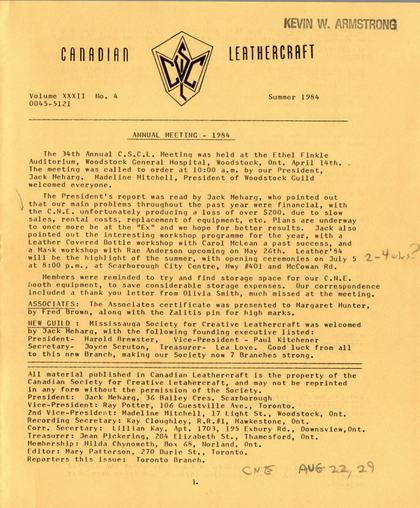
Canadian Leathercraft
Volume XXXII No. 4 Summer 1984
0045-5121
ANNUAL MEETING - 1984
The 34th Annual C.S.C.L. Meeting was held at the Ethel Finkle
Auditorium, Woodstock General Hospital, Woodstock, Ont. April 14th. The meeting was called to order at 10:00 a.m. by our President, Jack Meharg. Madeline Mitchell, President of Woodstock Guild welcomed everyone.
The President's report was read by Jack Meharg, who pointed out that our main problems throughout the past year were financial, with the C.N.E. unfortunately producing a loss of over $200. due to slow sales, rental costs, replacement of equipment, etc. Plans are underway to once more be at the "Ex" and we hope for better results. Jack also pointed out the interesting workshop programme for the year, with a Leather Covered Bottle workshop with Carol McLean a past success, and a Mask workshop with Rae Anderson upcoming on May 26th. Leather'84 will be the highlight of the summer, with opening ceremonies on July 5 at 8:00 p.m., at Scarborough City Centre, Hwy #401 and McCowan Rd. Members were reminded to try and find storage space for our C.N.E. booth equipment, to save considerable storage expenses. Our correspondence included a thank you letter from Olivia Smith, much missed at the meeting. ASSOCIATES: The Associates certificate was presented to Margaret Hunter, by Fred Brown, along with the Zalitis pin for high marks.
NEW GUILD: Mississauga Society for Creative Leathercraft was welcomed by Jack Meharg, with the following founding executive listed: President- Harold Brewster, Vice-President - Paul Kitchener Secretary- Joyce Scruton, Treasurer- Lea Love. Good luck from all to this new Branch, making our Society now 7 Branches strong.
All material published in Canadian Leathercraft is the property of the Canadian Society for Creative Leathercraft, and may not be reprinted in any form without the permission of the Society.
President: Jack Meharg, 36 Bailey Cres. Scarborough
Vice-President: Ray Potter, 106 Guestville Ave., Toronto.
2nd Vice-President: Madeline Mitchell, 17 Light St., Woodstock, Ont.
Recording Secretary: Kay Cloughley, R.R.#1, Hawkestone, Ont.
Corr. Secertary: Lillian Kay, Apt. 1703, 195 Exbury Rd., Downsview, Ont.
Treasurer: Jean Pickering, 204 Elizabeth St., Thamesford, Ont.
Membership: Hilda Chynoweth, Box 68, Norland, Ont.
Editor: Mary Patterson, 270 Durie St., Toronto.
Reporters this issue: Toronto Branch.
The founding president of the new Mississauga branch is printed here as "Harold Brewster". Page 8 and page 14 of this same issue print "Harold Brister". Both spellings are set out as printed.
Page 2
HONOURARY ASSOCIATE: Tom Swafford, St. Joseph, Missouri, was made an Honourary Associate for his long years of participation in the C.S.C.L. WESTON TROPHY: Madeliene Mitchell presented the Weston Trophy to Toronto Guild, who had scored an average mark of 86.8%. Congratulations. LIFE MEMBERSHIPS: Mae Corbett and Jack Layton (see write-ups this issue), were presented Life Memberships by Membership Chairman, Hilda Chynoweth.
NOMINATING CHAIRMAN: Hope Drysdale presented a full slate of officers and executive council members for the year 1984-1985,
QUESTION AND ANSWER PANEL: Jessie Strain, Bea Austin, Jean Newton, Ruth Haig, and Fred Brown answered a number of questions from members. The business meeting came to a close with Kay Cloughley announcing that Barrie and the Executive Council will host the 1985 Annual.
Following a delicious buffet luncheon, enjoyed by all, the afternoon demonstration session took place, from 1:30 to 4:30, interrupted by a coffee break and prizes from the draw table.
The demonstrations were as follows:
Acrylic Dyeing and Medallions - Ruth Haig Round Braiding and Decorative Stitches - Edith Melchior Tools and Sharpening - Walter Mickey
Gloves - Helen Wheaton
Making Homemade Stamping Tools - Dave McPherson Coupon and Credit Card Holder, Cheque Covers - Jean Hunter Filagree Leather - Bea Austin
Picture Frames - Velcro Fastener - Laura Bush Handstitching Variations - Karla Van Horne
DINNER: We journeyed, via hospital tunnel, to Cafeteria where we were greeted with smiling faces, a lei, Hawaiian punch and soft Hawaiin music, followed off by a matching dinner.
CRAFTSMAN AND SALON RIBBONS: Fred Brown, Chairman of the Council of Fellows, presented the Craftsman and Salon. Ribbons (listed later in this issue, illustrated), to the fortunate craftsmen of C.S.C.L. ENTERTAINMENT: Carol McLean presented a beautiful and interesting Slide presentation of Hawaii and the quilt display in which she took part a short time ago in Hawaii.
The end of a beautiful day!
Submitted by Muriel McKnight,
Publicity Chairman, C.S.C.L.
Photo albums of past events were on hand throughout the day for members to do some memory brousing through, and these were most enjoyed.
"Madeliene Mitchell" (this page only) is printed exactly so — a third spelling in this one issue alongside p1's "Madeline Mitchell" (masthead, twice) and the archive's usual "Madeleine Mitchell" elsewhere. Each page keeps the spelling it prints.
Page 3 — NEW ASSOCIATE: MARGARET HUNTER
NEW ASSOCIATE: MARGARET HUNTER
Margaret, who has been practising the craft of leathercraft for 3 1/2 years, has been a member of C.S.C.L. for 2 1/2 years, and is active with the Toronto Branch.
For instruction in leathercraft, Margaret has studied with Dave Trotter, at the Haliburton School of Fine Arts, with Jean Hunter, Clara Cavanagh, as well as learning about leather bottle covering from Carol McLean, Box making, with Fred Brown, and the art of colouring leather, as shown by Jessie Little.
Although active in the C.S.C.L. for only a relatively short time, her awards include three Craftsman Ribbons, presented for 2 wallets and a leather vest. She has also received an Honourable Mention for a wallet displayed at the annual C.N.E. Leather competition. Margaret has also worked as a helper at the C.N.E. booth for our Society.
This year she has been successful in her first attempt at the submission of pieces for Associate standing in C.S.C.L. Along with the certificate of achievement, Margaret was. presented with the Zalitis pin. These Silver pins were donated by Janis Zalitis to be given to the successful Associate candidate receiving highest marks. Articles submitted were:
(1) Handbag with gussets, hand-cut lacing, airbrush technique, unique application of straps (invisible).
(2) Carved belt
(3) Tooled wallet, hand-cut lacing, design borrowed from antique chairs.
(4) Vest- saddle stitched.
[Below the numbered list the page carries four hand-drawn sketches of the four pieces, each with its own hand-lettered caption: a shoulder bag ("HANDBAG (AIRBRUSHED)", item 1), a belt ("BELT - CARVED", item 2), a bifold wallet ("LACED WALLET", item 3) and a vest ("VEST (SADDLE STITCHED)", item 4), under the heading "ASSOCIATE PIECES". These captions are easy to weave into the list itself as a spurious table ("VEsT" after item 2, "(sappie... STiteveD)" splitting item 3's own text); set out here as the printed wording, with the captions described separately instead.]
ASSOCIATE PIECES
Page 4 — LIFE MEMBERSHIP - May Corbett
LIFE MEMBERSHIP - May Corbett
May Corbett was born and educated in Toronto, and after her marriage to Clarence, moved to Barrie. She is the mother of one son, Bob, and the grandmother of four.
May joined CSCL in 1958, during Barrie's first year as a branch.She became an Associate in 1961. Just a note to indicate May's willingness to become involved. She attended the October meeting as a visitor and at her second meeting (in November) was asked to become the treasurer, (all this before she had actually paid her membership fee), and, typical of May, she accepted!
For many years the recreation room of her home has acted as home base for the Barrie Branch, and our small collection of Weston Trophy plaques adorns the wall there. She has always been ready to make her home and time available to members for impromptu work meetings or social events.
She has held all of the positions in the Executive at the local level and is again the current Treasurer. She is the unofficial transportation committee of one, and very often the attendance of the Barrie members at Executive Council meetings and other functions depends on May's busy schedule.
May has served the General
Executive Council faithfully and well over the years, and is currently an elected director. She has served as Vice President, and was elected President at the Annual meeting of 1975, and filled that position until she handed over the reins to Beulah Reynolds at the Annual Meeting of 1978,
May is very capable in all phases of leathercraft, being particularly noted for the many unique and attractive bottles she has covered in leather.
In 1959, May was appointed the Citizen of the Year for Barrie. This honour was in recognition of her devoted and tireless labours on behalf od several of the local charitable organizations and her church. May is also on the executive and is active in the Simcoe Adult Skating Club, and finds time in her busy schedule to go pleasure skating each week during the season. Her spacious home in its parklike setting with well kept garden around it attests to her "green thumb",
For her loyal and faithful service to the CSCL Executive and the membership in general, it is a pleasure to award her an honourary Life Membership today.
Life membership in the C.S.C.L. is the highest honour that we are able to afford any member. It is our way of saying"thank you" for years of devoted work, furthering the craft, and helping others to enjoy leathercraft.
We are most pleased to print he resumes of our newest Life Members, May Corbett of Barrie Branch and Jack Layton of Belleville Guild, two members who are most deserving of this well-earned recognition.
Page 5 — LIFE MEMBERSHIP - Jack Layton
LIFE MEMBERSHIP - Jack Layton
Jack took his first lessons in leathercraft in the spring of 1955 or 1956. He was one of the first leather workers to help form the Belleville Leather Guild. He joined the C.S.C.L. in 1965, and has served several times on the Executive Council since that time.
He has been in faithful attendance at many workshops and conventions. Jack has been a great help to members of the Belleville Guild and also to the C.S.C.L. Jack has always been there when needed, and has acted as "Mr. Fix-It" when we have had to put on displays, as well as always being ready with his camera to take pictures and relay them to us later on the screen.
His jovial personality certainly keeps our Guild together.
Jack designed the small maple leaf pin which nearly all C.S.C.L. members use. Al Stolman was pleased to get one of these pins. Jack demonstrates for us at the C.N.E. every year that he is able to attend. He celebrated his 80th birthday in April, 1982. Throughout the years, Jack has served in every executive position in the Belleville Guild from President on down.
The original prints "Stolman" without the h at this mention; kept exactly as printed.
[Below the Jack Layton biography the page is a hand-drawn illustration, not prose. Boxed heading "WESTON TROPHY / Toronto Branch" over sketches captioned "Laminated Weather Bar", "Jewellery Chest" and "Morocco Pocket Secretary" — the same three Toronto Branch pieces critiqued on pp6-7. Below that, boxed "Salon Awards" over sketches captioned "Grey Soft Handbag", "Raku Pottery Container with Leather Covering", "Sunflower Wall Plaque", "Gnome", "Jewellery Chest of Drawers", "Leather Covered Bottle", "Checker Board" and "Butterfly Wall Decoration" — matching the Salon Awards list on p8 — captioned "Sketches by Lillian Kay". Read as running text rather than as a drawing, this reduces to six lines of nonsense ("jetton TROPHY", "RAku POrTrery", etc.); replaced here with this description, nothing invented.]
Page 6 — CRITIQUE - ARTICLES SUBMITTED FOR THE WESTON TROPHY COMPETITION 1984
CRITIQUE - ARTICLES SUBMITTED FOR THE WESTON TROPHY COMPETITION 1984
HAMILTON BRANCH 82.6
Handbag
- a beautiful bag
- beautifully finished inside and out - lovely dye job
- sits straight
- covered rivets
- pleasing filagree design on flap
Covered Bottle
- nice dye job
- interesting braiding - a little uneven. It was suggested that this might be corrected with a bone folder - nice treatment of handle
- bottom well covered
- a good example of bottle covering
Belt
- nicely stamped
- well dyed
- beautifully finished
- good edges
Canteen
— one end of the belt not good leather - great stitching
- excellent use of airbrushing - gradual blending at edges
Sporran
- very stiff
- good mystery braiding
- ingenious use of a badge for moulding flap decoration - an interesting piece
TORONTO BRANCH 86.8
Grey Soft Handbag;
= shape suitable to the leather chosen - light weight and gentle to the touch
- secret compartment is wide enough to hold Metro Pass or keys - Excellent craftsmanship
- pleasing appearance
Ceramic and Leather Piece
— a very pleasing combination of ceramic and Leather - warm earth tones
Morocco Pocket Secretary
- hand-cut matching lacing
- good craftsmanship
- well finished
6.
Page 7
TORONTO BRANCH CONT'D
Laminated Weather Bar
- Five laminations
- beautiful finish on edges - a very elegant piece
Laminated chest
- a beautiful piece of work
- legs laminated as well as the rest.
- knobs are screwed on - not just cemented, laminated over screws - drawers beautifully hung - everything fits very evenly - rich glow - pleasing red undertone on finish - a very valid use of leather as a medium in the use of this technique
WOODSTOCK BRANCH 84.4
Butterfly (93)
- beautiful wall piece
- excellent colour job
- good definition in modelling
- VERY well done
Checkerboard
- a great deal of work on this piece, on a very nice piece of leather - beautiful corners, - a good fit - the checkers have great edges - altogether, extremely well done
Tray
- a beautiful lamination - top grain on each side - took a lovely finish - a beautiful patina
-handle not only reinforced - it feels nice to the grip - sits flat
- very careful workmanship - no careless tool marks or nail marks
Picture Frame
- nice use of morocco leather
- beautiful skiving
- sits well
- in one place it had been rubbed down so that the texture of the morocco was removed.
- nice piece of work
Silhouette
- very accurate cutting and measuring - better if inside edges were bevelled - unusual design
- pleasing to look at
CONGRATULATIONS GO TO THE TORONTO BRANCH, 1984 WINNERS OF THE WESTON TROPHY, WITH A MARK OF 86.8
Page 8 — CRAFTSMAN AWARDS - ANNUAL MEETING 1984 - WOODSTOCK; SALON AWARDS
CRAFTSMAN AWARDS - ANNUAL MEETING 1984 - WOODSTOCK
| Bea Austin | Handbag, One-Piece Tan Purse |
| Harold Brister | Large Knife Case |
| laura Bush | Brown Morocco Wallet, Photo Album |
| Clara Cavanagh | Green Covered Bottle, Inlaid Book |
| Hilda Chynoweth | Handbag |
| Mary Anne Crawford | Pocket Secretary |
| Hope Drysdale | Covered Bottle |
| Sharon Gogiswili | Leather-Bound Book, Stationery Holder |
| Ruth Haig | Small Covered Bottle, Rectangular Box, Belts (2) |
| Jean Hunter | Chequebook Cover |
| Marg Hunter | Belt, Soft Handbag, Steerhide Handbag |
| Joy Hutcheson | Decorative Bowl |
| Nora Huyck | Handbag |
| Lillian Kay | Gnome |
| Jessie Little | Weather Station |
| Loreen Manuel | Pins, Sunflowers, Butterfly Wall Decoration |
| Carol McLean | Checkerboard |
| Jean Pickering | Picture Frame, Floreated Picture Frame |
| Beula Reynolds | Trug Gathering Basket |
| Gladys Riddell | Chest of Drawers |
Karla Van Horne Black Clutch, Carved Wallet, Covered Canteen,
Lanyard
SALON AWARDS
| Clara Cavanagh | Green Covered Bottle |
| Marg Hunter | Steerhide Handbag |
| Lillian Kay | Gnome |
| Loreen Manuel | Sunflowers, Butterfly Wall Decoration |
| Carol McLean | Checkerboard |
| Gladys Riddell | Chest of Drawers |
We are indebted to Jean Hunter for her work in recording all of the above awards, as well as resumes of the Weston Trophy competition pieces. As we have come to take for granted, Jean has presented the work in clear, concise language, and has managed to make each page a "design" of type layout. Thanks!
Page 9 — CHEQUEBOOK COVER
Jean Hunter, F.C.S.C.L.,
CHEQUEBOOK COVER
Annual Meeting, Woodstock, 1984.
PLEASE READ ALL INSTRUCTIONS BEFORE BEGINNING WORK!
Cut out project in light-weight leather..Do not cut out holes for pocket zipper or cheque-book slit yet.
Case leather and edge-crease edges where needed. Dye any exposed edges now - you may not be able to get at them later. If using straight edges and single pockets, you may want to skive and turn edges under 1/4 inch, cementing carefully to avoid loosening of "hem".
Edge-dye and finish (Burnish all raw edges on pockets, inserts etc.,) as you go along.
Mark seam stitching line in outer (front) pocket and punch carefully. A crooked line will spoil the look of your project. If saddle-stitching this seam, use marker and awl. If using a running stitch, use fine thonging chisel. (See also Page 2.) Dampen and fold pocket rectangles. Plan pockets so that the two best sides are up. When folded, the edges should fit exactly. If you have not cut precisely, trim at this point.
Right Pocket: Mark slit for cheque-book from pattern. Punch slit ends with small oo or ooo punch, then carefully cut a double line joining top and bottom of the punch holes, using a steady hand, a steel edge and a very sharp knife. I find that two or three gentle cuts with the knife give a better line than one heavy cut, especially on thin leather. Dye and edge-dress the slit edges now, before you forget them.
Left Pocket: If you are having a zipper on this pocket, decide whether you want it at the top or front of the pocket.
If at the top, mark fold points at edges of pocket. Draw a line with a sharp pencil or scratch awl to within 1/2 inch from the centre line above and below the centre line. Using about an 8 mm, punch, or a #6 with a little help from a scalpel if you need it, punch a hole at each end of the centre line to give a neat edge to the zipper end. Then cut out your spaced lines to complete the zipper space. If your zipper is medium or heavier in weight,
Then cut out your spaced lines to complete the zipper space. If your zipper is medium or heavier in weight, adjust the aperture accordingly. If you think it would be easier, cut the lines first and leave enough space for the round punch holes, or simply square the centre cut.
A diagram beside this paragraph, labelled "Centre line", "1/2" in" and "1/4" above and below centre line", illustrates the aperture just described; the running prose already covers what the diagram shows.
Edge dye and dress the raw edges.
Use a #2 edge creaser or adjustable creaser and marking wheel to mark stitching holes. I make my holes at this point in the leather, using a stitching awl. It is easier to do this before the zipper is cemented in. Cement the zipper to the leather, using white cement. Let season for a few minutes. Now punch your holes again, penetrating the zipper cloth. If the zipper is too long, you can give it a "stitched-over" stop, move the stop up to where y ou want it if you are lucky enough to have one with a metal stop, or put on a commercial stop, obtainable at dress-goods shops or at Tandy's.
Page 10
Cheque-book Cover Cont'd
If zipper is to be placed on front of double pocket: mark centre line for zipper down 5/8 inch from fold, and in 1/2 inch from each end.
Mark and cut as for top zipper, with holes in 1/2 inch from each end, and cut 1/4 inch each side of centre line. Cut carefully. Mark and punch holes, and cement zipper in place as in top placement. (remember to edge dye and dress before cementing. )
Saddle-stitch Zipper in place.
Front Pocket:
This pattern was made to accommodate a small 2 1/2" x 4" calculator or vinyl windows. If using another size of calculator, the pattern will need to be adjusted to fit. Now you see why I said read first!
Mark the top and bottom of the stitching line on the fromt pocket. Place a ruler just a shade to the left of a line joining these points. For saddle stitching, mark and punch stitches with awl. For running stitch, punch holes with an angle punch. From the pattern for the left (zipper) pocket, mark where the stitching holes should be and punch them similarly to fromt pocket holes. Align the holes and stitch front pocket. This is for tolerance in thickness of the calculator. After you have done one and have seen how it goes, the two pockets can be securely fastened together and one set of holes punched.
To set the pocket edges: Scuff the middle pocket edges where fromt pocket will be attached. Dampen the fromt pockets so that they can be shaped and stretched a little. Lay the calculator in place and mould the leather around it, stretching and tucking as necessary to make a smooth pocket which will be adequate but not baggy. Put a filler of cardboard in the other side, thickness depending upon what you intend to put in it. Actually, a cardboard filler may be made for the calculator side, also. Cement the pockets in. If desired, a keeper may be cemented or rivetted at the back of the front pocket, to come down through a slot bar for security.
The original types "fromt" for "front" four times on this page; all four are kept exactly as printed, and the two correct "front"s elsewhere on the page are the paper's own too.
Cement lining to outer shell, folding gently a little at centre for ease in later closing. Cement the two pocket sections in place. Breathe a sigh of relief and lace your project.
Bits and Pieces:
A pen-holder may be attached to the underside of the right pocket. Not being too trusting, I anchor mine with eyelets.
If you have done everything on the square and up-and-up, and your zipper comes out looking as if you had put it in when deep under the influence of whatever, cut it off and treat yourself to two single pockets, both with right sides out, of courses Never surrender!!!
The calculator pocket may be placed on either side. The small pocket is great for a tiny note book, a stamp folder, or even a tiny change purse-cum-spare key-holder for emergencies.
Page 11
Cheque-Book Cover - Page two
POCKET SECTIONS - CUT 2
Be sure to have top quality on matching sides when folded.
For Centre-fold Zipper placement
For front zipper placement.
Before cutting these spaces for zippers, be sure to check the width of the zipper you are using. The whole line may need to be lowered, widened, or whatever.
Stitching Line
These marks are not intended to show hole intervals, just the line placement.
Stitching line
Stretch gently and ease in corners
Stretch gently anad ease in corners, moulding over calculator or cardboard.
[This is the second pattern sheet for Jean Hunter's cheque-book cover, printed at the 1984 C.S.C.L. Annual. Its captions sit around two pattern-piece diagrams — two zipper-placement rules drawn across the upper piece, a caption running vertically down the centre of it, and two stretching notes beneath the lower piece — so they are set out below one after another rather than as they fall on the sheet. The sheet's handwritten dimensions are 7 3/8" across the top and 7 3/8" down the right side, 2 3/4" at the left, 2 3/4" and 4 3/4" on the lower piece, and 7 1/2" for the overall width, written inverted along the foot; the folio reads "page 11.". "anad" is printed as it stands.]
Page 12
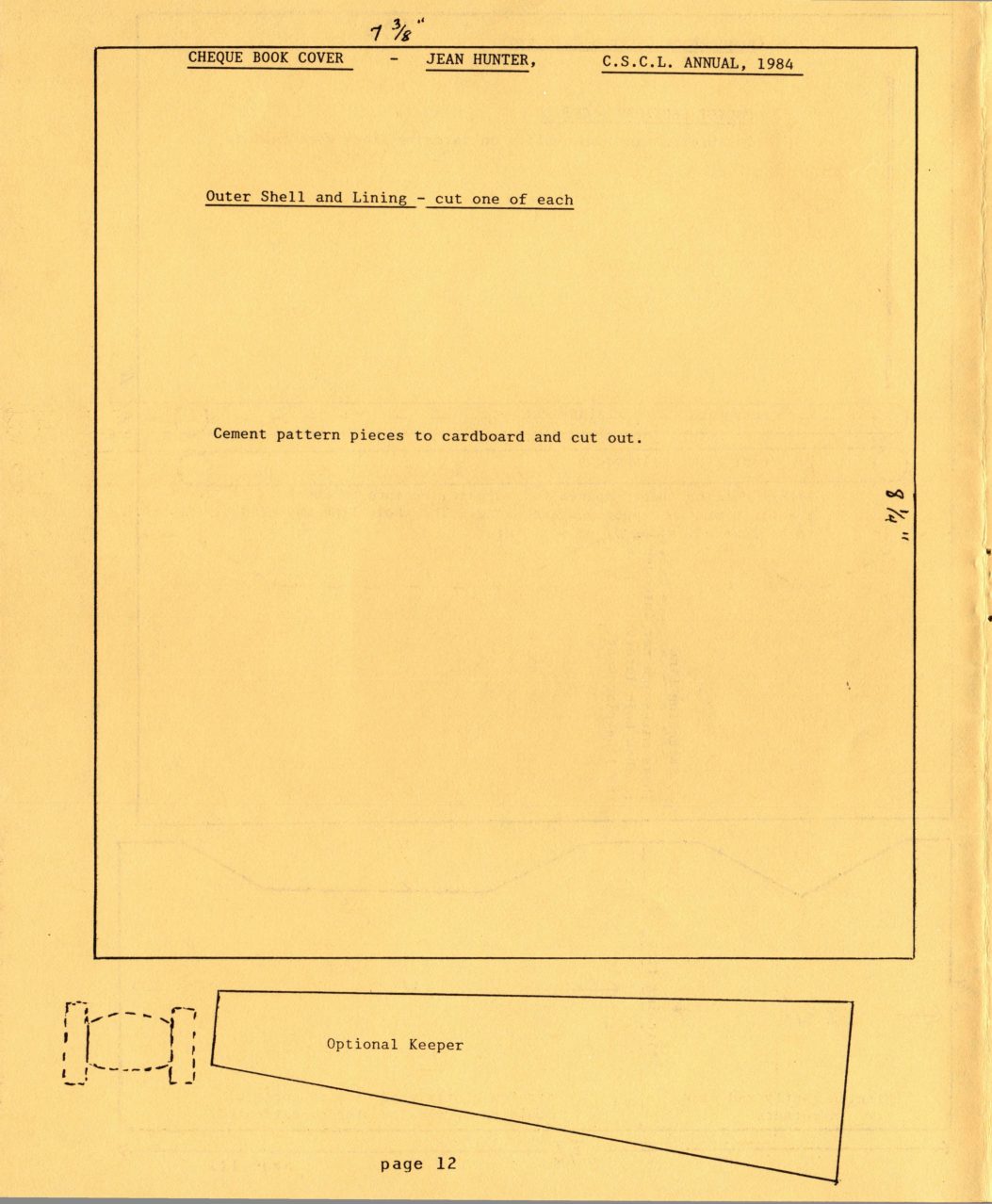
CHEQUE BOOK COVER - JEAN HUNTER, C.S.C.L. ANNUAL, 1984
Outer Shell and Lining - cut one of each
Cement pattern pieces to cardboard and cut out.
Optional Keeper
[This page matches the print exactly. It is a cheque-book-cover pattern by Jean Hunter, printed at the 1984 C.S.C.L. Annual; the shell/lining outline (7 3/8" x 8 1/4", handwritten) and the keeper strip are pattern-piece diagrams with no further captions.]
Page 13 — COLLECTIONS OF "CANADIAN LEATHERCRAFT" Preparing Leather; Shop Tip
COLLECTIONS OF "CANADIAN LEATHERCRAFT"
We were pleased to hear from Librarian Jean Hunter, that our sets of Canadian Leathercraft, first published in 1951, (Sept.) and now finishing its 32 nd year of publication, have been assembled, ready for binding. These will be included in the Larmour Memorial Library"boxes" that circulate from Branch to Branch.
We are sure, when these are completed, that Members-at-large will also find access to these invaluable sets in some manner, by writing to Jean Hunter. In the meantime, we ask that ANY member having past issues from the "good old days" that perhaps are no longer of use to the member, remember to save these and either contribute them to a new craftsman, or directly to Jean Hunter or to the Editor for use for newer members of the organization. Most of the design articles, shop tips, patterns, etc. are as relevant today as the year that they were printed. Some subjects, such as glovemaking, make be almost impossible to find covered as well in any other source.
Jean Hunter can be reached at Snelgrove, Ont. L0P 1M0, if you would like to contribute older sets to the Library.
Past issues are generally Sold at each Annual Meeting, and members may wait to purchase missing issues there. Fortunately, Xerox equipment has now improved considerably, and copies taken off our older coloured sets are now quite clear. Up to recent years, items printed on coloured paper have been somewhat difficult to reprint.
Preparing Leather- by Gladys Riddell
When you have chosen your piece of leather for a pattern, check the piece thoroughly for blemishes, holes and other flaws. Mark these on the flesh side with a pencil or pen dot. On the top side, stick a straight pin into the blemished area to give yourself a guide to work around. If the flaws are prominent, this system works well.
There are always some marks that do not show well, and another system can be used to find them. Take some very diluted Garnett's Antique Golden Tan dye, and wash it over your leather and let dry. The flaws will appear clearly. and the dye is so dilute that it won't affect the eventual colour of the article.
Shop Tip from Bob Muma
When Morocco has been rubbed down until surface is smooth and shiny, moisten surface and stiple, using a stiff-bristled brush to strike the texture back into the morocco. You have to have a staccato movement- the brush has to bounce. This is best done while the leather is still moist at the time the problem started. Thanks, Bob.
Page 14 — SHARPENING TOOLS
SHARPENING TOOLS by Harold Brister
President, Mississauga Branch
Editors Note: We are indeed pleased to have a contribution from the newest part of our organization. The following article is a summary of the recent "sharpening workshop" that Harold presented at the Toronto Branch workshop. We scribbled furiously, and hope that we have not made any serious errors in techniques used. It was a most interesting and informative evening for Toronto!.
Materials to have on hand for sharpening tools:
600 grit and 400 grit emery paper packet of paper matches jeweller's rouge sharpening stone oil for stone tongue depressor popsicle stick meat skewer assorted cords and thongs piece of leather for strop piece of cardboard (index card weight) calling card or business card contact cement
Now, if that sounds like an odd assortment of items, Harold Brister manages to make sharpening even the most complicated shapes of tools a simple task, using some of these unlikely items.
If a tool is badly nicked or very dull, it should first be sharpened on the stone, with a thin film of oil applied and then wiped off, making just a slightly oily surface.
Generally, however, a tool can be merely "touched up" using some of this mysterious shopping list of Harold's.
Jeweller's rouge should be applied to firm cardboard, of the type used for index folders, etc., and this cardboard strop can be used for most tools that need stropping. Rouge can also be put on a leather strop, if this is more comfortable to you, as many of us have always used a leather strop.
600 grit and 400 grit emery paper should be glued to the tongue depressor, to make a miniature "paddle" of emery. This is used on many tools. (Listed later in article).
The same emery paper should be glued around the point of a meat skewer (wooden skewer). This is an invaluable device for fitting inside punches and other tools with holes. (More later)
Paper matches are a MUST for Harold, as, although he doesn't smoke, he DOES sharpen all his small tools, even saddle-stitching diamond awls, most of which need only a quick touch up every few minutes to stay razor sharp. The striking strip on a match pack is a perfect small sharpener, fine in texture, handy to carry, and MOST reasonable! A business card, onto which jeweller's rouge has been rubbed, makes a perfect small strop to go with the match packet.
The popsicle stick is handy for smaller emery paper "paddles" and, if you have a particularly small opening, the inside edge of which must be sharpened, and nothing seems to fit, try a strip of wood from an apple basket, with the emery glued onto it.
Page 15
Specific Tool Sharpening Tips:
Swivel Carver: A ruby tipped carver should not be sharpened, but if a serious nick occurs, you may be able to get a specialist in stone cutting (faceting), to re-sharpen.
A non-ruby tipped carver can be a much more effective tool if it is stropped between cuts with jewelers rouge on the small card that was suggested. If real sharpening is needed, position it in a Craft Tool sharpening holder, set at 20° angle, then sharpen it on a stone with a film of oil. Finish by stropping on card with jeweller's rouge. Olfa Knife: These snap-off, throw-away blades can last much longer if they are stropped on card with rouge regularly. Don't waste them! Groover for Saddle Stitching: Strop this on your small card, and the small hole in it can be sharpened by a touch-up with the wooden meat skewer that has the 400 grit emery paper glued to the tip. Harold suggests that these meat skewers be sharpened in an ordinary pencil sharpener if the tip breaks, and then regive a piece of emery on them. This small piece on the groover is really better replaced, he suggests, rather than trying to sharpen a broken tool. Its cheaper with time and money, as this is a very inexpensive item.
Belt Edger: Since these come in different widths of cutting edge, these tools look like a problem case. However, since the sharpening device is merely a piece of cord or thonging, looped over a hook on the edge of the workbench, and then rubbed down with a bar of jeweller's rouge, it is an easy matter to find the right size of thonging to use as a strop for each different edger. Strop the edger down the thong to sharpen. 7
Punches: Use the skewer with the emery covering first on the inside, to sharpen inner edges, then use the tongue depressor with the the fine emery on it to go around the outside, in a circular sharpening motion, while rotating the tool that is to be sharpened. Rotate the tool slowly, and you can even finish with jewellers rouge on a small paddle.
Belt Slot Hole Punches: These slot punches are best sharpened with an assortment of tongue depressors, or popsicle sticks, or even strips of basket wood onto which fine emery is glued, Find the one that fits the slot well, then sharpen the inner edge, and then the outer, with the circular motion of the paddle that we mentioned above, It is CRITICAL in all these punches, whether round or oval, to keep the top angle of the tool edge at the same angle as it was made. This correct angle should never be flattened out, or it does not cut well. Rampart Gouge: This adjustable-depth groover can be sharpened by using the skewer tool on the interior, and then the tongue depressor paddle on the exterior. If the gouge edge is very bad, this centre piece can be replaced entirely. Keep the top angle correct when you paddle the edges with the emery paddle in a series of overlapping circles as described above.
In summary, Harold pointed out that a tool that is stropped gently and very often, will likely hardly ever need to be sharpened on a stone. Keep a small strop at hand at all times for maximum efficiency from your tools.
Page 16 — WORKERS FOR THE C.N.E. BOOTH
Toronto Branch is pleased to announce that Bruce White, (who was scheduled to speak at the April meeting that had to be cancelled due to the date conflict with the Annual,) has kindly consented to speak at our June meeting, Friday June 8th, on "Methods of Lacing".
Time: 7:30 p.m. Place: St. Martin in the Fileds Church, Keele St., one block north of the Bloor and Keele subway station.
Visitors always welcome!!
We are planning to enclose the C.N.E. letters and application (entry) blanks with this issue of Canadian Leathercraft. If you require entry blanks, or further information, please contact Gladys Riddell at 65 Southport St., Apt. 204, Toronto M6S 3N6 Tel: 762-7466. Gladys Riddell and Jack Meharg have consented to once again serve as show convenors for the C.N.E. PLEASE NOTE: We have been asked to try numbering articles for sale in a slightly different manner this year, with ALL items of one design AND price being listed on tags & one line of the entry, instead of breaking these items up into groups of twenty as has been the custom in past years. In other words, if you have 36 trillium pins, and 45 key fobs, instead of listing them on the tags as Trilliums, $4.00 each, (Code initials ) 1-20 and Trilliums, $4.00, (Code initials) 21-36 and Key fobs, 1-20, 21-40& 41-45, now all the key fobs would be on one line, and the tags would read (Code initials)1-45. This has been changed to suit the people who are presently doing the final checking of items before return of unsold articles, Gladys Riddell and Lillian Kay.
SUPPORT THE C.N.E. SALE THIS YEAR!! Once again we are charging 20% for the Society for sales commission, and since we now are required to pay a sustantial rental for the space, we require quite a considerable number of sales before we accumulate enough profit to pay the rent! Rather than increase the sales commission, we would like to present the public with a wide enough variety of items, at reasonable prices, to attract a large number of sales, leaving the craftspersons with a better return on their work. Try new items this year, for variety, and remember that many people are purchasing small items as Christmas gifts to put away, so vary your stock!
WORKERS FOR THE C.N.E.
BOOTH:
Please contact Gladys Riddell at(416)762-7466 or at the address given earlier on this page, as we require workers for every day. (Also demonstrators! )
CODE INITIALS FOR SALE (C.N.E-)
Most members have their code initials, but, if in doubt, contact Gladys, or Jack Meharg, or, if unable to reach either of these busy people, feel free to contact your editor, who will see that the information gets back to you as promptly as possible.
LEATHER '84
Our Biennial. show will have. been judged by the time this is received, and we hope that you will take the time to attend the. opening, Thursday, JULY 5th. at SCARBOROUGH CITY CENTRE, Borough Dr., Hwy. # 401, at McGowan South, Scarborough, Ont. Awards will be presented at that time.
Reporters Next Issue: Members-at-large Material Due: Oct. 1/84
Page 17 — ANNUAL C.N.E. SALE - THE CANADIAN SOCIETY FOR CREATIVE LEATHERCRAFT
ANNUAL C.N.E. SALE - THE CANADIAN SOCIETY FOR CREATIVE LEATHERCRAFT
Dear Member;
Our Annual demonstration and sale will be held in the Arts, Crafts and Hobbies Building of the Canadian National Exhibition, (just inside the Dufferin Gates, C.N.E. grounds, Toronto), from Wednesday August 15th to Monday, September 3, 1984,
As usual, all articles for sale will be screened by the "Fellows", but it is the responsibility of each craftsman to see that the workmanship is good. Your articles can be mailed, or delivered by hand, to arrive between August l- August 13th. All articles received after this date will be set aside until they can be screened by the "Fellows". If you are mailing articles, they can be delivered to: Mr. & Mrs. F.C. Patterson,
270 Durie Street, Toronto. M6S 3G3.
***¥Please Note: C.S.C.L. is no longer responsible for loss of articles due to shoplifting during the sale. However, all possible precautions will be taken to ensure that articles are not lost through theft. Members are asked to NOT submit articles on stands to be placed OUTSIDE the sale cases as these are difficult to supervise.
Each branch is responsible for providing a planned demonstration, as well as a person who will look after the cash on a particular day that they have signed up for on the duty roster of the Sales Convenor. Members with large quantities of work for sale are expected to spend proportionate time staffing the booth. (Sales Convenors addresses at end of page.) GENERAL RULES: Three (3) entry forms are to be filled out. Two copies should be enclosed with your articles, and the third copy is for your records. Special emphasis is placed on neatness and clarity when making out the forms. If carbon paper is used, please make sure that the copies are identical as there have been problems with carbon copies in the past.
PRICING ARTICLES FOR THE C.N.E. SALE:
(a) Make sure that your correct designated code is used. (i.e. Hope Drysdale - DH). If you do not have a code, please contact Sale Convenor.
(b) SPECIAL NOTE: Present sales(final) checkers, G. Riddell & L. Kay, request that this year ALL ARTICLES THAT ARE THE SAME, (i.e. Maple Leaf pins, @ $4.50 each) should be listed on ONE line, rather than in groups of twenty, as has been customary. Do NOT mark individual tags in the group of similar articles as, for example, DH1, DH2, etc, instead, mark EACH piece submitted in the group in a similar manner. For example, if you have 44 Maple Leaf Pins, @ $4.50 each, and 23 keycases at $9.00 each, your entry form should appear as below, (using Hope Drysdales name code):
| Article | No. Sent | Selling Price (each) | Selling Price (Total) | Code & Number |
|---|---|---|---|---|
| Maple Leaf Pins | 44 | 4.50 | $198.00 | DH 1-44 |
| Key Cases | 23 | 9.00 | $207.00 | DH 45-67 |
[This worked example is printed as a table; its data rows are easy to lose entirely, welding the two-line header ("Article / No. Sent / Selling Price (each) / Selling Price (Total) / Code & Number") into two garbled "Article" rows and leaving Maple Leaf Pins/Key Cases with no figures. Set out below as printed: Maple Leaf Pins 44 @ $4.50 = $198.00, code DH 1-44; Key Cases 23 @ $9.00 = $207.00, code DH 45-67 — matching the prose above ("44 Maple Leaf Pins... and 23 keycases").]
(c) Use price tags approximately 3/4" in size, and NEVER use masking tape on an article as the gum ruins the finish. String tags are best. (d) IMPORTANT! If you are pricing sets, put the sets in boxes. DO NOT put separately priced items together in a box, as confusion arises. (e) All forms and entry tags MUST be filled out in INK ONLY!
Tags must be marked ON ONE SIDE ONLY. EACH INDIVIDUAL ARTICLE MUST have an individual price tag on it. (Pairs of earrings are considered together as 1 article ).
Please follow these simple rules and PLEASE PARTZSIPATE.
Twenty (20) percent of the selling price will be deducted by the C.S.C.L. for expenses. All articles unsold by the end of the C.N.E. will be packed and taken to Sales Convenor's home for checking with the books, and items will be returned to the Branch Representatives at the September
Executive Council meeting.
SALES CONVENORS FOR 1984: (Contact for information or Sale Code)
| Mrs. Gladys Riddell, | Jack Meharg |
| 65 Southport St. Toronto M6S 3N6 | 36 Bailey Crescent, |
| Apt.# 204 Tel: 416-762-7466 | Scarborough, Ont. Tel:439-5873 |
Mailing Address: c/o Mr. & Mrs. F.C. Patterson, 270 Durie St. Toronto
M6S 3G3
*** Articles are requested for booth display, and should be entered as "FOR EXHIBITION ONLY".
Remember... your participation helps YOU AND the C.S.C.L.! Please enter!:
[Restored against the printed page: the heading "PRICING ARTICLES FOR THE C.N.E. SALE:" stands on its own line, the rule before it ends "...make sure that the copies are identical", and the sale checkers are the "sales(final) checkers".]