How the Society started
← The Society · five accounts of the Society’s beginning, written between 1951 and 1992
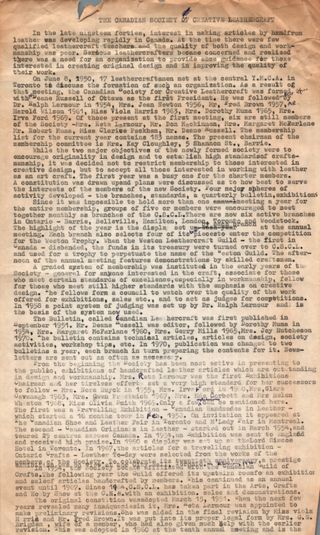
This page holds the five accounts the Society left of how it began. They agree on the main facts. A group of experienced Canadian leathercraftsmen met in Toronto to discuss common problems in the spring of 1950 (Canadian Leathercraft No. 1, September 1951, page 1). The meeting was held on Thursday 8 June 1950 at the central Y.M.C.A., Toronto, with seventeen people present and Robert Muma in the chair (Spring 1960, pages 7–10, reprinted word for word in Spring 1975, page 2). A constitution was drafted and approved over the 1950–51 season, and the first newsletter, Canadian Leathercraft No. 1, appeared in September 1951 with Deane H. Russell of Ottawa as the Society’s first President and Editor (No. 1, pages 1, 7 and 12). It was founded as the Canadian Society of Creative Leathercraft — of, not for — and the name changed between 1965 and 1969.
- 26 Presidents, 1950–2025 — Deane Russell the first, Sean Dalgetty the last
- 20 editors of the newsletter, 1951–2026 — Deane H. Russell the first, Lauchlan Harrison the last
- 12 branches, and the Members-at-Large
- 17 founders at the meeting of 8 June 1950; eleven at the informal meeting of 1948
- Largest membership on record: 205, in 1978–79
- At the end: 17 members in good standing cast the dissolution vote, 10 May 2025
- 253 issues of the newsletter, September 1951 to Fall 2026
They differ in detail, and each account keeps its own words below; the differences are stated here rather than resolved. The first newsletter gives no day and no address, saying only that the craftsmen met “in the spring of 1950”; the day, Thursday 8 June 1950, comes from the later newsletters (Spring 1960 page 7, Spring 1975 page 2, Spring 1990 page 8). Robert Muma, who presided at that meeting, begins earlier still, with the Weston Leathercraft Guild of 1947 and an informal meeting of eleven craftsmen at 53 Avenue Road in 1948, where the other accounts open in 1950. He gives the officers elected that June as Deane H. Russell, President, Mrs. Margaret McFarlane, Vice-President, and himself Secretary-Treasurer (Spring 1960, pages 7–10); the Executive printed on the last page of the first newsletter sets out six officers, with Mrs Reta Larmour as Secretary and Robert Muma as Treasurer (No. 1, page 12). The speech read at the 1981 Annual Meeting says only “about 1950”, dates the founding of the International Assembly of Leathercraftsmen to 1953 where the newsletters of the day give a weekend in Buffalo in October 1954, and dates the Weston Trophy to 1956 or 1957. The c. 1971 typescript counts the Assemblies differently again from the account written from the newsletters.
Two further pieces on the same beginning stay on their own pages, being a newsletter and an anniversary article rather than retellings: Canadian Leathercraft No. 1, September 1951 and Fifty Years of Leather Art.
On this page: The final count, 1950–2026 · From the Society’s first newsletter, 1951 · The Society’s own short history, c. 1971 · The Society’s First Ten Years, by Robert Muma · In the Beginning, read at the 1981 Annual Meeting · Memory Lane — the earliest letterhead Executive
The final count, 1950–2026
Each account below gives the Society’s numbers as they stood in the year it was written. These are the totals for the whole of its life, counted from the Society’s own rolls of its officers, its branches, its members and its newsletter.
- Presidents: 26. Twenty-six people held the office, from Deane Russell, elected at the founding meeting of 8 June 1950, to Sean Dalgetty, President from 2023 until the Society was dissolved in 2025 — counted from the roll of the Society’s people and the offices they held. The c. 1971 history named eight Presidents to 1969; Muma gave the succession to 1960.
- Editors of the newsletter: 20. From Deane H. Russell, who edited Canadian Leathercraft No. 1 in September 1951, to Lauchlan Harrison, who edited the last issue in 2026 — the same roll. The c. 1971 history named five editors to 1970.
- Branches: 12, and the Members-at-Large beside them, who were not a branch: Barrie, Belleville, Hamilton, London, Mississauga, Norland, Peterboro, Petrolia, Tillsonburg, Toronto, Windsor and Woodstock (the branch histories). Muma counted seven branches in the spring of 1960; the c. 1971 history said six were active.
- Founders: 17. Seventeen people were at the organizational meeting of 8 June 1950, and Muma, who chaired it, names every one; eleven were at the informal meeting at 53 Avenue Road in 1948 (Spring 1960, pages 7–10).
- Members: 205 at the most, in 1978–79. That is the membership in a single year, and the highest yearly figure the Society’s papers record. Over seventy-five years many more people belonged, came and went: the papers name close to seven hundred people in all, members and others, and every one is listed in People of the Society. The Society stood at 205 members in 1978–79; the next year’s report notes that “our membership has fallen from the total of 205 members last year at this time” to 178 (Minutes of the 29th Annual Meeting, printed as an appendix to the 1980 Annual Meeting booklet, pp.4–10). The membership list for the year of the c. 1971 history “contains 183 names”, and that figure was reprinted unaltered in Summer 1990. Other counts along the way: over 200 in 1974–75, 175 in 1983, 100 in 1993, 25 in 2021–22 and 32 in 2025. Over the whole life of the Society 347 members are named with a branch in the branch rosters, the earliest joining in 1951 and the latest in 2023. At the end, 17 members in good standing cast the vote that dissolved the Society at its 75th Annual General Meeting, 10 May 2025 — eleven present and six by proxy (Fall 2026, page 6).
- The newsletter: 253 issues, from Canadian Leathercraft No. 1 of September 1951 to the final issue of Fall 2026 (the run of the newsletter).
From the Society’s first newsletter, 1951
1950–1951 · from Canadian Leathercraft No. 1, September 1951 · with the change of name, 1965–69.
- Met in Toronto in the spring of 1950
- Constitution drafted and approved over the 1950–51 season
- First newsletter: Canadian Leathercraft No. 1, September 1951
- First President and Editor: Deane H. Russell, Ottawa
- Founded as the Canadian Society of Creative Leathercraft — of, not for
This account is assembled from the Society's own first newsletter, Canadian Leathercraft No. 1, September 1951 — the Society's first newsletter — with two later pages that continue the story.
The meeting in Toronto, spring 1950
The Society's own telling of its beginning opens the first newsletter under the heading “A New Craft Society — HOW IT STARTED”. It begins not with a date but with four remarks, printed as though overheard: that beginners in smaller centres are poorly served for instruction; that “there is a growing need for an association of specialists to help the many who want to explore their craft beyond its elementary stages”; the question “What's wrong with contemporary leathercraft in Canada that it merits such little recognition at important art-craft exhibitions?”; and the answer, “Leathercraft will become recognized as a serious and worth while craft in Canada when Canadians stop copying and start creating.” (No. 1, page 1.)
These, the page says, “were among the many which confronted a group of experienced Canadian leathercraftsmen when they met in Toronto to discuss common problems in the spring of 1950”. The group sought opinions from art galleries and from other organised art-craft societies, and matched them against the views of working craftsmen. The page gives no day and no address. Later newsletters date the meeting to Thursday 8 June 1950, at the Central Y.M.C.A., Toronto: Spring 1960 page 7, reprinted word for word in Spring 1975 page 2, and Spring 1990 page 8.
A name, and a constitution
“As a result of a keenly aroused interest among so many skilled leathercraftsmen, plans were laid to form a non-profit, educational organization under the name of ‘The Canadian Society of Creative Leathercraft’.” The preposition is of, not for; it stayed that way for some eighteen years. “During the fall, winter and spring of the 1950-51 season, the new Society's constitution was drafted and approved”, and charter members prepared a programme of service to students. The page closes: “Thus was born the idea; thus was formed the Society.” (No. 1, page 1.)
Whom it set out to serve
Under “AIMS and OBJECTIVES” the Society is careful to say that originality of design, though “a major objective”, is not the only one: “by far the greater number of leathercraft students enjoy practising their craft for values other than being able to produce original or creative leathercraft” — recreation, new associations, useful articles in fine leathers. Copyists, it observes, often reach “remarkable degrees of technical skill” in modelling, stamping, incising, carving, hand colouring or construction. “Consequently, the Society desires to serve all who are interested in some phase of hand working leather as an absorbing and useful art-craft.” (No. 1, page 3.)
The newsletter then names six kinds of reader it hoped to serve, and the list is the plainest statement of the Society's intended reach it printed: the novice of one to three years; the experienced student of three to five; the leathercraft teacher, for whom participation “may well offer educational credits of unequalled value”; the skilled craftsman of five years and over; the tanner, supply house, manufacturer or manufacturer's representative; and the general public — “any appreciators of fine articles in leather”. (No. 1, pages 3–4.)
Five members make a branch
Page 7 sets out how a local group could affiliate: an application for a group of “not less than 5 members” went to the President of the national Society, and on approval by the executive council the group's officers received “a copy of the by-law governing formation of local sections”. The value of belonging is given as the chance to overcome “the feeling of working alone”, to share new ideas and experiments, and to receive the newsletter and travelling displays. (No. 1, page 7.)
Ten years later the terms had grown and the Society restated them on the front page of its Autumn 1961 issue, under “FORMATION OF NEW BRANCHES”. Five or more people anywhere in Canada could still apply. But by then every branch was entitled to enter the Inter-Branch competition for the Weston Trophy, and its members to exhibit at the Annual Meeting and at the International Assembly of Leathercraftsmen, to enter the Canadian Handicraft Guild competition at the Canadian National Exhibition, to receive the newsletter, and to submit articles for sale at the Society's Annual Christmas Sale. Branch members could also apply for Associate and Fellow membership, “since these memberships are indicative of a high degree of skill at the craft the qualifying requirements are of necessity quite rigid”. Applications went to Mrs. Nora Huyck, R.R. 3, Newmarket. (Autumn 1961, page 1.)
The first Executive
The last page of the first newsletter is signed “Very sincerely, Your Executive”, and prints the six of them with their home addresses. This is the earliest full Executive the Society printed at the time it served.
President and Editor "CANADIAN LEATHERCRAFT"
    Deane H Russell, 116 O'Connor Street, Ottawa
Vice-President, Mrs Margaret McFarlane, 1810 Lawrence Ave West, Weston
Secretary, Mrs Reta Larmour, 59 High Park Boulevard, Toronto
Treasurer, Robert Muma, 62 McGill Street, Toronto
Chairman Membership Committee, Mrs Edith Roscoe, 277 King St, Weston
Advertising Manager, Don W MacKinnon, 6 Irwin Street, Toronto
Deane H. Russell had until that summer written “Leathercraft Lobby”, a weekly column in the R.A. News, the Dominion Civil Service newspaper, and resigned it “in order to accept his appointment as Editor of the new national bulletin” (No. 1, page 7). He is the Society's first President; the Honorary Life Fellowship given him in 1954 was given to him on retiring from that office.
This list is older than the one the Society itself called its earliest. In 1992 President Don MacLeod found, at the bottom of a box of old letterhead, a pair of sheets carrying “a complete list of the then Executive” headed by Dr. Ralph K. Larmour, and the newsletter printed it as a trip down Memory Lane. That list is undated. Larmour was the Society's second President — the Spring 1975 retrospective says so in as many words — so the letterhead Executive follows this one rather than preceding it.
What the Society meant to do first
Two announcements close the first newsletter. “Canadian Handmades in Leather”, a travelling exhibition organised by the Society, was to start a coast-to-coast tour early in January 1952 and to be offered to “all responsible leathercraft groups in Canada”; work and applications had to be in by 1 December, to the Chairman of the Exhibition Committee at 116 O'Connor Street, Ottawa — the President's own address. And a circular, “Qualifications for Membership in the Canadian Society of Creative Leathercraft”, was about to be mailed to every registered General Member, setting out how to qualify for Associate or Fellow rank; the exhibition's Board of Selection would review entries for those ratings at the same time. (No. 1, page 8.)
The departments planned for the newsletter are listed on page 4, and most of them ran for decades: editorials on creative design and on standards, technical articles by Canadian craftsmen, foreign country news, book reviews, special events, workshop tips, letters to the editor — and “Who's Who in Canadian Leathercraft”, the column that in 1973 became the Who's Who in Leathercraft series from which most of this archive's biographies are taken.
Who paid for it
Eleven firms are thanked on page 11 as Sustaining Members, “for pioneering support and good will”, and between them they map the Canadian leather trade of 1951 from Vancouver to Montreal:
Bedford Fine Leathers Ltd — Vancouver
The Birt Saddlery Co Ltd — Winnipeg
Walter E Charron & Son — Montreal
Clarke & Clarke Leathers — Barrie
Craftlace Limited — Montreal
A Davis & Son Limited — Kingston
King Brothers Leather Company Limited — Whitby
Lewis Craft Supplies Ltd — Toronto
Ottawa Valley Leathercraft Studios — Ottawa
Riley's Hobby Service — Hamilton
Wickett & Craig Co Ltd — Toronto
Clarke & Clarke of Barrie and Lewis Craft Supplies were still giving prize money to the Society's competitors ten and more years later; the Ottawa Valley Leathercraft Studios of 116 O'Connor Street were the President's own.
Of, and then For
The Society was founded as the Canadian Society of Creative Leathercraft and is known now as the Canadian Society for Creative Leathercraft. The change was made by amendment to Article VIII of the Constitution, and the fullest account of it is a retrospective printed in Spring 1975, which sets it in the paragraph for 1968–69: “A change in the Constitution, Article VIII, was made to change our name from Canadian Society of Creative Leathercraft to Canadian Society for Creative Leathercraft. Woodstock branch was formed in 1968.” (Spring 1975, page 8.)
The old name outlived the vote on paper. When Don MacLeod opened his box of stationery in June 1992 there were still “over 200 envelopes” and a pile of embossed letterheads reading of, and the Society posted two issues of the newsletter in them rather than waste them.
Written from the Society's own pages: Canadian Leathercraft No. 1, September 1951 (pages 1, 3, 4, 7, 8, 11 and 12), with Autumn 1961 page 1 and Spring 1975 page 8. The Executive is on page 12 and the Sustaining Members on page 11. The Memory Lane letterhead Executive is set out below.
The Society’s own short history, c. 1971
c. 1971 · from the undated typescript History of CSCL.
- Two typed pages, undated, written for a year in which no International Assembly was held — so c. 1971
- Eight Presidents named in succession, 1950 to 1969
- Five editors of the Newsletter named in succession, 1951 to 1970
- Eight Exhibitions Chairmen named in succession, from the first to 1969
- Membership that year: 183 names
- Printed again, almost word for word, as the lead article of the Summer 1990 Newsletter — the fortieth-anniversary issue — 183-member count and all, nineteen years out of date
This is a transcription of two pages of typescript, headed THE CANADIAN SOCIETY OF CREATIVE LEATHERCRAFT, with no author, no date and no addressee. It is the Society writing its own history for someone outside it. The page also carries pencil and ink corrections in at least two hands; where one of them adds a fact, it is marked below as a hand annotation.
How the document is dated
Nothing on either page gives a year. Four things date it. The list of Presidents ends with “Mrs. Irva Ford 1969”. The list of editors ends with “Mrs. Joy Hutcheson 1970”, and the same paragraph says that “In 1970, publication was changed to two bulletins a year”. A hand annotation dates the Society's twentieth-anniversary exhibition at Toronto City Hall to February 1970. And page 2 ends: “Unfortunately, membership in the American Guilds is decreasing and there will not be an Assembly this year” — the International Assembly of Leathercraftsmen ran to 1970 and then stopped. A document written after the 1970 anniversary and in a year with no Assembly is most likely of 1971; the archive dates it c. 1971 and says so rather than printing a year the paper does not carry.
The Presidents, 1950–1969
“On June 8, 1950, 17 leathercraftsmen met at the central Y.M.C.A. in Toronto to discuss the formation of an organization. As a result of that meeting, the Canadian Society for Creative Leathercraft was formed, with Deane Russell of Ottawa as the first President.” The succession then runs:
| President | From |
|---|---|
| Deane H. Russell | 1950 — the first, of Ottawa |
| Ralph K. Larmour | 1954 |
| Jean Newton | 1956 |
| Fred Brown | 1957 |
| Harold Wilson | 1961 |
| Viola Harris | 1963 |
| Dorothy Muma | 1965 |
| Irva Ford | 1969 |
The register the site builds from the newsletters themselves agrees with all eight, which is worth stating: this list was typed from memory or from a file, and it comes out right. It also settles a stretch the newsletters leave ambiguous — Dorothy Muma from 1965 to 1969 — against two stray rows in the register that give other names for 1967 and 1968.
The page then names the founders still in the Society twenty-one years on: “Of those present at the first meeting, six are still members of the Society — Mrs. Reta Larmour, Mr. Don MacKinnon, Mrs. Margaret McFarlane, Mr. Robert Muma, Miss Clarice Packham, Mr. Deane Russell.” That is six of the seventeen who met at the Y.M.C.A., named, and it is the only such list the archive holds. The membership list for the current year, the page adds, contains 183 names, and the chairman of the membership committee is Mrs. Kay Cloughley of 5 Shannon St., Barrie.
The Newsletter and its editors, 1951–1970
“The Bulletin, called Canadian Leathercraft, was first published in September 1951.” Its editors, in the document's own order:
| Editor | From |
|---|---|
| Deane H. Russell | 1951 — the first |
| Dorothy Muma | 1954 |
| Margaret McFarlane | 1960 |
| Gerry Mills | 1965 |
| Joy Hutcheson | 1970 |
“The bulletin contains technical articles, articles on design, society activities, workshop tips, etc. In 1970, publication was changed to two bulletins a year, each branch in turn preparing the contents for it. Newsletters are sent out as often as necessary.” That sentence explains a change the newsletters themselves show: the quarterly of the 1950s and 1960s thins to two issues a year in 1970–72, and it was a decision, not a lapse.
The exhibitions, and the women who ran them
“From the beginning the Society has been most active in presenting to the public exhibitions of handcrafted leather articles which are outstanding in design and workmanship. Mrs. Reta Larmour was the first Exhibitions Chairman and her tireless efforts set a very high standard for her successors to follow.” The successors, as the page names them:
| Exhibitions Chairman | From |
|---|---|
| Reta Larmour | the first |
| Nora Huyck | 1955 |
| Irva Ford | 1960 |
| Clara Cavanagh | 1963 |
| Gwen Prestwich | 1967 |
| May Corbett | 1968 — with Helen Wheaton |
| Helen Wheaton | 1968 — with May Corbett |
| Olivia Smith | 1969 |
Two notes on those names. The typescript prints Mrs. Mâe Corbett, with a hand-drawn accent; the archive publishes her as May Corbett and records Mae as the form printed, which is what it does elsewhere for her.
The exhibitions themselves are given as a short list, and “only a few can be mentioned here”: Canadian Handmades in Leather, a travelling exhibition which began a sixteen-month tour in February 1952 and was shown by invitation at the Canadian Shoe and Leather Fair in Toronto and at the M'Lady Fair in Montreal; Canadian Originals in Leather, which started out in March 1954 and toured twenty-nine centres across Canada; an exhibition sent to England in 1954, which “received high praise”; a display at the Lord Simcoe Hotel, Toronto, in 1960; and in 1967 the articles chosen from members' work for the travelling exhibition Ontario Crafts — Leather To-day. For its twentieth anniversary a prestige exhibition was on view at the City Hall, Toronto — in February 1970, a hand has added.
“In 1954 the Society became affiliated with the Canadian Guild of Crafts. The following year the Guild offered its upstairs room for an exhibition and sale of articles handcrafted by members. This continued as an annual event until 1967. Since 1964 C.S.C.L. has taken part in the Arts, Crafts and Hobby Show at the C.N.E. with an exhibition, sales and demonstrations.” Those two sentences are typed one on top of the other on the paper, the second struck over the first, and both are legible only on close reading.
The branches, and the Weston Trophy
“Since it was impossible to hold more than one annual meeting a year for the entire membership, groups of five or more members were encouraged to meet together monthly as branches of the C.S.C.L. There are now six active branches in Ontario — Barrie, Belleville, Hamilton, London, Toronto and Woodstock.” That is a dated census of the branches at one moment.
“The highlight of the year is the display set up by each branch at the annual meeting. Each branch also selects four of its pieces to enter the competition for the Weston Trophy. When the Weston Leathercraft Guild — the first in Canada — disbanded, the funds in its treasury were turned over to C.S.C.L. and used for a trophy to perpetuate the name of the Weston Guild.” The words “by each branch” are a hand annotation. The Society's own account of where its senior trophy came from is told here, and again in Spring 1957 and Winter 2011–12.
Grades of membership, and the point system of 1958
“A graded system of membership was instituted in the early years of the Society — general for anyone interested in the craft, associate for those who meet certain standards of excellence, especially in workmanship, fellow for those who meet still higher standards with the emphasis on creative design. The fellows form a council to watch over the quality of the work offered for exhibitions, sales etc., and to act as judges for competitions. In 1958 a point system of judging was set up by Dr. Ralph Larmour and is the basis of the system now used.” This corroborates, in the Society's own summary, what the article on the Associate and Fellow ratings sets out at length from the newsletters — and it attributes the point system to one man and one year.
The constitution: 1951, and again in 1960
“The original constitution was adopted March 15, 1951.” That is a precise date the newsletters do not give. “When the next few years revealed many inadequacies in it, Mrs. Reta Larmour was appointed to make preliminary revisions. She was aided in the final revision by Miss Viola Harris and Mr. Fred Brown. It was put into its proper legal form by Mrs. G. G. Brigden, wife of a member, who had also given much help with the earlier revision. This was adopted in 1960 at the tenth annual meeting and is the framework within which the Society operates to-day.”
The International Assembly, and the year it did not come
“In 1954 sixteen American leathercrafters from Rochester visited a C.S.C.L. display at the International Hobby and Homecraft Show in Toronto and another interesting and educational event began — The International Assembly of Leathercraftsmen. Canada was the host on several occasions. At the fourth Assembly, C.S.C.L. proposed the inauguration of a Salon of Leathercraft. All articles were reviewed by competent judges and those worthy were awarded Salon ribbons. A few years later Craftsmen awards were started. Canadians have been well represented both in the Salon and in the Craftsmen group.”
The archive's account of the Assemblies, written from twenty-two newsletter pages, dates the founding weekend to Buffalo in October 1954 and the Salon's beginning to Detroit in 1956. The newsletters agree: the Salon was decided on at the third Assembly, Detroit, 1956, and first held at the fourth.
The last thing the document says about the Assembly is the sentence that dates it, and it is an ending: “Unfortunately, membership in the American Guilds is decreasing and there will not be an Assembly this year.” In its place the Society was enlarging its own meeting — “Our Annual meeting is being expanded this year to include a dinner at the end of the day — giving more time for demonstrations and viewing of displays.” The document closes by saying that new members are always welcome and that memberships can be accepted at that meeting, which is the sentence of a body that expects to be read by a stranger.
Printed again, nineteen years later
This typescript did not stay in a drawer. The Summer 1990 Newsletter — the Society's fortieth-anniversary issue — opens with an unsigned article headed, word for word, THE CANADIAN SOCIETY OF CREATIVE LEATHERCRAFT, and its text is this document's, almost unchanged: the same seventeen names at the Y.M.C.A., the same eight Presidents, the same editors, the same Exhibitions Chairmen — even the same “membership list for the current year contains 183 names”, a 1971 figure printed nineteen years later as if current, and never corrected.
Reprinted rather than rewritten, it settles two things the carbon left ambiguous here. The sentence a hand had added about the twentieth-anniversary exhibition — “To celebrate its twentieth anniversary, a prestige exhibition was on view at the City Hall, Toronto, in February 1970” — appears in the Newsletter's own running text, not set off as a later insertion, so it was read as part of the document rather than added afterward. And of the two sentences typed one over the other about the Guild affiliation and the C.N.E., the Newsletter prints only the second: “Since 1964, C.S.C.L. has taken part in the Arts, Crafts and Hobby Show at the C.N.E. with an exhibition, sales, and demonstrations” — confirming which line the strikeover on the typescript left standing. The Newsletter's own typesetting also reads Mrs. Mae Corbett, without the typescript's hand-drawn accent, agreeing with the spelling this page already publishes. (1990-summer pp2–3, read at full page.)
Written from the two-page typescript History of CSCL, in the Document Archive. The document is undated; c. 1971 is this archive's reading of it, argued on the page above. Quotations are given as typed, with the Society's own abbreviations expanded and obvious typewriter slips silently closed up; the hand annotations are identified where they carry a fact. The archive publishes May Corbett where this page types Mâe Corbett. The Assembly count differs from the account written from the newsletters, and the difference is stated rather than resolved.
The Society’s First Ten Years, by Robert Muma
1947–1960 · Spring 1960, pages 7–10 · reprinted unaltered in Spring 1975, page 2.
- Written for the tenth anniversary by Robert Muma, F.C.S.C.L., who chaired the organizational meeting of 8 June 1950 and was the Society's first Secretary-Treasurer
- Names all eleven present at the informal meeting of 1948 and all seventeen present at the founding meeting of 1950
- Gives the Society's presidential and editorial succession 1950–1960 in the words of a man who watched it
- Counts seven branches in 1960: Toronto, Hamilton, London, Peterborough, Tillsonburg, Barrie and Petrolia
- Reprinted word for word in Spring 1975 under the title The Society's First Twenty-Five Years — including the sentence “This is the tenth anniversary”
This is the fullest account of its own beginnings that the Society printed in the years this archive covers.
A mature tree
“This is the tenth anniversary of the Canadian Society of Creative Leathercraft,” the essay opens. “This organization as we see it today is a mature tree with a number of Branches in Toronto, Hamilton, London, Peterborough, Tillsonburg, Barrie and Petrolia. In outlining the growth of this tree we ought to know something of its roots and something of the seed from which it germinated — something too of the environment which gave it shape.” (Spring 1960, page 7.)
That is a seven-branch census taken in the spring of 1960, and it is worth reading slowly: Petrolia appears in it, and appears elsewhere only in a branch-application notice of Fall 1957. Peterborough is spelled in full here, where the Society's own notices of 1956 say Peterboro.
1947 and 1948: the roots
“As far as we know, prior to 1947 there were no leathercraft organizations at all in Canada. In that year, Mrs. Edith Roscoe organized the Weston Leathercraft Guild.”
“Some time during the following year, 1948, sensing a need for a wider organization, Mrs. Roscoe called a meeting of craftsmen and craft house representatives at 53 Avenue Road, which is now the Piccadilly Club. This old church was being used by the Handicrafts Guild for a series of craft courses that year.” Eleven people were there, and Muma names every one of them: Edith Roscoe, Margaret McFarlane, Clarice Packham and Mrs. Cannon from Weston; Jack and Margaret McDougall; Ray Potter and Evelyn Hamill from Lewiscraft; Bob Wallace, Ruth Home, and — in his own phrase — myself. “We discussed leathercraft standards and original design, the need for an organization, etc. Nothing concrete was done and we adjourned to meet again if any need arose.”
“About the same time the Ottawa Valley Leathercraft Guild was formed by Deane Russell.” Those two guilds — Weston and the Ottawa Valley — are the Society's two parents, and Russell and Roscoe are the two people who ran them.
Ruth Home is printed Home, not Horne, on both the 1960 page and the 1975 reprint. Evelyn Hamill is printed Evelyn on both pages.
February 1950: two or three pieces accepted
“In February, 1950, the Toronto Art Gallery held an exhibition of contemporary crafts and a great many pieces of leather were entered but only two or three were accepted. Something must be wrong. What was it? Everybody was discussing the question.”
Muma wrote to Deane Russell on 12 March 1950 and quotes his own letter: he questioned “the possibility that a solution might be in an organization of leathercraftsmen on a high standard of creative craftsmanship.” Russell answered on 23 March, and that letter is quoted too: “We would be most interested in seriously exploring such a plan with you during our spring visit to Toronto… If you care to explore the idea with others in the meantime, we would be glad to come to Toronto prepared to present some rather important information to any group who might make up a first meeting of this nature.”
“The idea was just a larger development of a trend or growth already started, and the meeting finally set for June 8, 1950, at the central YMCA was the actual sprouting of the organization we have today.”
8 June 1950: the seventeen
Muma then résumés the minutes of the founding meeting, which Reta Larmour submitted as Secretary. “The purpose of the meeting was to discuss the formation of a guild or society to further the aims and interests of leathercraft in general, which would have representation from many groups of leathercraftsmen.”
“There were seventeen people present at this first meeting: Robert Muma, Chairman; Deane H. Russell, Ottawa; Ray Potter, Miss E. Hamill, Miss Judy Drope and Stan McQuarrie representing Lewiscraft; Mrs. Margaret McFarlane and Mrs. Edith Roscoe, Weston Leathercraft Guild; Miss Clarice Packham, Clarke and Clarke Leathers; R.K. Wallace, Bob Wallace Hobbycraft; Harold Booth, Hamilton, Booth's Hobbies; Dr. and Mrs. R.K. Larmour; Mr. and Mrs. Don MacKinnon; Mrs. J. Carter, Miss Edith Howison.”
The list is worth counting, because it is how the paper itself counts: the seventeen include two married couples counted as pairs and seven people present for a trade — Lewiscraft, Clarke and Clarke, Bob Wallace Hobbycraft, Booth's Hobbies. The Society was founded by working craftsmen and by the firms that sold them their leather, in one room, together.
“Deane Russell opened the meeting with a discussion of contemporary design and felt that in this field an organized leathercraft society could do much to further Canadian leathercraft. The name chosen at this time for the Society was The Canadian Society of Creative Leathercraftsmen.” Officers elected were Deane H. Russell, President; Mrs. Margaret McFarlane, Vice-President; Robert Muma, Secretary-Treasurer. “Also elected were an Advisory Council of: Harold Booth, Hamilton; Mrs. Reta Larmour, Toronto; Mr. Louis Zimmerman, Montreal; and one member from Ottawa to be elected later.”
Three decisions of that first hour outlast it. “It was suggested that each new member should submit his work to a Board of Selection which would vote on whether such work was of sufficiently high quality for the craftsman to be admitted” — the germ of the Associate and Fellow ratings. “A Constitution was discussed… It was decided that a tentative Constitution should be drafted by the chief executive officers.” And “an initial Treasury was set up by an assessment of $1.00 from everyone present.” There was a collection of leathercraft on display — luggage, purses, wallets and wall plaques — and “the meeting was voted a distinct success.”
The succession, 1950–1960
“Deane Russell continued as President of the Society for four years giving a great deal of his time and energies developing the Society through this formative period. Our quarterly 12-page bulletin, Canadian Leathercraft, came into existence in September, 1951 with Deane as Editor until he resigned from both positions in 1954.”
“Dr. Larmour followed for two years as President, succeeded by Mrs. Jean Newton for one year, and Mr. Fred Brown, who begins his fourth term this year. Dorothy Muma became Editor of the Bulletin in 1954 and is relinquishing it this year to Mrs. Margaret McFarlane.”
That is the whole first decade in two sentences, and it agrees with the succession the Society set down some eleven years later in its own two-page typescript. It also dates the Newsletter's first change of editor precisely: Margaret McFarlane took it over in 1960, ten years after being elected the Society's first Vice-President.
Where the work was shown
“When we were barely two years old in 1952, our President attended the Annual Meeting of the Canadian Arts Council in Montreal with a brief from our Society and we were accepted into full membership in that coordinating body of the arts and crafts in Canada now known as the Canadian Conference of the Arts.”
“In February, 1952, our first travelling exhibition called Canadian Handmades in Leather was organized by Mrs. Reta Larmour, the Exhibitions Chairman. During the sixteen months it was on the road, it travelled an estimated 14,000 miles, was shown 39 separate times, and was seen by approximately 150,000 people. The second Travelling Exhibition, called Canadian Originals in Leather, went out on March 1st, 1954, and toured 29 centres across Canada. The name of this second exhibition indicates the extent to which we had already achieved our goal in encouraging leathercraftsmen to attempt original design.”
“Since 1955, Mrs. Nora Huyck has been in charge of Exhibitions.” Muma then lists where the Society's work had gone: nine of its own Annual Meetings, five International Assemblies, the First and Second International Hobby and Homecraft Shows in the Coliseum, the Canadian Shoe and Leather Fair of November 1952 in the Automotive Building, two years at the Handyman Show, M'Lady Fair in Montreal in December 1952, and the Pacific National Exhibition of 1955, “where we received the Bedford Cup for the best leathercraft and the PNE Medal for the Best Club.” A special exhibition was running in the Lord Simcoe Hotel as he wrote.
“Special mention should be made of the exhibition which was assembled and sent on invitation to the First British International Handicrafts, Homecrafters and Hobbies Show at Olympia, London, England, in 1953. This was visited by 100,000 people during nine days and the officials reported to us that our display of leathercraft was the best single exhibit in the show.”
The travelling-exhibition paragraph prints 150,000.
1954, and how the Assemblies began
“1954 was a big year in our history. It was then we became affiliated with the Canadian Handicrafts Guild, and this has proven to be a valuable association in various ways, especially in regard to the annual CNE competitions and the pre-Christmas sale of work through the Guild shop.”
“In February, from 5–12, 1954, we arranged an extensive exhibition of leathercraft in conjunction with a sale and demonstration of work for the International Hobby and Homecraft Show at the Coliseum. One evening during this show a delegation of sixteen members from the Eastern Leathercraft Guild of Rochester, N.Y., visited our display and met with us later at the home of Dr. & Mrs. Larmour, where plans were briefly discussed for organization on a larger scale. In April, sixteen of our members returned the visit to the Rochester Guild and plans were made for the First International Assembly of Leathercraftsmen at the Hotel Statler in Buffalo in the fall of that year.”
That is the Assembly series' origin told by a man who was in the room for it, and it names the evening it began: a chance visit by sixteen Rochester craftsmen to a Toronto trade show in February 1954, and a return visit in April. “With one exception this has continued as an annual event in which our Society has played a very important role” — the exception being 1958, when the Assembly was tried biennially.
“For the Fourth International Assembly of Leathercraftsmen held in Rochester, our Society had proposed the inauguration of a Salon of Leathercraft to be based on art standards. A jury of Rochester arts and crafts authorities of national distinction selected the pieces and made four Honor Awards, which were won by four of our Charter Members.”
Grades, teachers, and a framework that had to be rebuilt
“Early in our history we set up the graded membership system: General members, Associates and Fellows. This has had much to do with making us keenly aware of leathercraft standards, and other organizations have called on us to provide qualified judges for leathercraft competitions. We also developed a system of grading teachers of leathercraft according to their experience and training.”
The essay ends on the Constitution, and its metaphor is the one the Society kept: “Every organization, in order to function properly, needs a set of rules. The Constitution not only provides a set of rules but architecturally provides the framework of the building. This framework of our Society was begun at the organizational meeting and rapidly took shape through many Executive meetings during the first few years. However, many weaknesses became apparent and had to be repaired. Indeed, whole sections of the structure had to be torn out and rebuilt and new sections added.”
“The architect in charge of this very important job of reconstruction has been Mrs. Larmour, who, with the expert help of Mrs. Gel Brigden, the wife of one of our members, has worked untiringly anticipating our Society's needs and checking the legal angles… Now on our tenth anniversary we are happy to have adopted this Constitution in its finished form. Now we have a sound foundation.”
“Mrs. Gel Brigden” is Lorna Brigden, identified in this archive from three later pages that give her own name for the same work. The 1960 Constitution she helped Reta Larmour draft is the subject of its own article.
The essay was reprinted in 1975 without being rewritten
Page 2 of Spring 1975 carries the heading THE SOCIETY'S FIRST TWENTY-FIVE YEARS. It is not a new essay. It is this one, reprinted word for word, and the first sentence under the new title still reads: “This is the tenth anniversary of the Canadian Society of Creative Leathercraft.” The 1960 branch census — Petrolia and all — is reprinted unaltered, and so is the sentence about Fred Brown beginning his fourth term “this year”, fifteen years after he did.
Both pages were set on the same typewriter text and the 1975 printing is on orange stock. The consequence for anyone reading this archive matters more than the curiosity: every statement of fact on Spring 1975 pages 2–5 is a statement about 1960, not about 1975. It is a reprint, and should be cited as Muma 1960.
What it settles, and what it does not
It settles the two dates the Society's founding turns on — the informal meeting of 1948 at 53 Avenue Road, and 8 June 1950 at the central YMCA — with a list of who was in each room, written by the man who chaired the second. It gives the presidential and editorial succession for the first decade. It gives the Assembly series a beginning that no later account gives.
It does not date the branches. Seven are named in 1960 and only their existence is stated; the archive holds founding dates for Barrie, Toronto, Hamilton, Woodstock and Belleville from elsewhere, and none at all for Petrolia. Nor does it name the four Charter Members who took the Honor Awards at the Fourth Assembly.
Compared word for word against the Spring 1975 reprint, pages 2–5, and against the original typescript. The essay is quoted at length rather than paraphrased because it is the Society's only first-hand account of its own founding, and the man who wrote it presided at the meeting whose minutes he is quoting.
In the Beginning — a history read at the 1981 Annual Meeting
1950–1957, recalled in 1981 · Spring 1981, pages 8–9 · a speech given at the Annual Meeting of 1 May 1981.
- A short, Genesis-styled speech given by Helen Wheaton, Chairman of Fellows, at the Annual Meeting of 1 May 1981, printed in the next Newsletter because the editor “could not resist including” it
- Recounts the Society's own founding, “about 1950”, and the setting of its first Associate and Fellow Standards
- Dates the International Assembly of Leathercraftsmen's founding to 1953 — a year earlier than the contemporary newsletters' own account of a weekend in Buffalo, October 1954
- Names Robert Dengler as the Assembly's “father, (or Godfather, if you prefer)”
- Credits the Assembly's Advisory Board with the Salon and Craftsman Awards, and dates the Weston Trophy to 1956 or 1957, when the Weston Leather Crafters guild closed and gave the Society its remaining funds
The full report was held over to the next issue, but the Spring 1981 editor “could not resist including” the speech: “Although we will be reporting on the C.S.C.L. Annual of May 1st, 1981 in the next issue, we could not resist including the following brief speech that was presented at the Annual by Chairman of Fellows, Helen Wheaton.” What follows is that speech entire, quoted in full — it is short, it names the Society's own turning points in the order they happened, and it is the only place in this archive that tells the story as a story rather than as a set of dates.
“In the beginning, about 1950…”
“In the beginning, about 1950, there was a group of people who worked in leather. These people said: Let there be a Leathercraft Society! AND— C.S.C.L. was born. AND— It was good. Then it was felt by the group that Standards should be set up. AND— The Associate and Fellow Standards were set. AND— The first Associate and Fellow members were elected. AND— It was good.” Nothing here is new — the founding meeting of 8 June 1950 and the Standards that followed it are already the best-documented facts this archive holds — and it credits them, plainly, to “a group of people who worked in leather” rather than to any one officer.
1953, and “the American invasion”
“In 1953, the Americans invaded the Canadian Society for Creative Leathercraft. AND— The Americans saw that what the Canadians were doing was good, AND— They said: Let there be an International Assembly of Leathercraftsmen. AND— The INTERNATIONAL ASSEMBLY OF LEATHERCRAFTSMEN (I.A.L.C.) was born. Mr. Robert Dengler being the father, (or Godfather, if you prefer.) AND— It was good.” The date is a year earlier than this archive's own account, built from the newsletters of the day, which places the founding weekend at Buffalo in October 1954. Both cannot be exactly right, and the contemporary report governs; this page states the disagreement rather than choosing between a first-hand notice and a Chairman's after-dinner memory twenty-seven years on. What the two accounts agree on is who is given the credit — Robert Dengler, whom Dr. Larmour's own 1964 citation for his Honorary Membership calls the Assembly series' “Instigator” — a second, independent naming of the same man in the same role, seventeen years apart.
The Salon and the Craftsman Award
“The Advisory Board of I.A.L.C. met, AND— They said: Let there be an award given in recognition of Excellence in Design, AND— The SALON award was born, and awarded at future assemblies. AND— It was good. It was then seen that there were a great many articles excellent in Craftsmanship but were not original in concept. So it was said: Let us have an award for these excellently crafted pieces. AND— The Craftsman Award was born. AND— It was good.” The Salon's own origin is told at greater length, and slightly differently, in the Society's account of the Assemblies: there it is the Society's own proposal, decided on by the Executive Committee at the third Assembly, Detroit, in 1956 and first held at the fourth, Rochester, in 1957, not a decision of an Advisory Board meeting on its own. The reasoning behind the second award — fine craftsmanship without original design deserving a prize of its own — is not written down anywhere else in the archive; this speech is the only source for why the Craftsman Award exists, even where it is not the fullest source for when.
The Weston Trophy, 1956 or 1957
“In 1956 or 1957, the Weston Leather Crafters decided to close operations and they donated their remaining funds to the C.S.C.L. AND— To give the Branches of the Society something to work for, the Weston Trophy was born. AND— It was good. The practice of giving out these Awards has continued over the years to this day. AND— It is seen to be good.” This is the second account in the archive of where the Society's senior branch trophy came from — the c. 1971 typescript gives the same story without a year, naming the donor “the Weston Leathercraft Guild — the first in Canada.” Both agree the Guild's own closure funded the Trophy; this one adds a year, 1956 or 1957, which fits the trophy, though the Spring 1957 newsletter says the Weston Guild had disbanded “a few years ago” — Edith Roscoe's Weston Leathercraft Guild was already several years old by 1950, and the Trophy's own first recorded winner, London Branch, was in 1957.
It ends where it began, on the same word: “The practice of giving out these Awards has continued over the years to this day. AND— It is seen to be good.” Whether Helen Wheaton meant the piece as history or as a joke at the Annual dinner is not this page's to decide — it can be read as both.
Written from Spring 1981, pages 8–9. The piece is quoted in full except for its own closing paragraphs, which turn to an unrelated “Twenty-Five Years Ago” column and are not part of the speech. Where this account's dates differ from the fuller, contemporary record — the founding of the International Assembly and the Salon's origin — the difference is stated on the page rather than resolved in either direction.
Memory Lane — the Society’s earliest letterhead Executive
Found 1992 · by Don MacLeod, 1992 President · printed Fall 1992, page 14.
In June 1992 a box of the Society's oldest stationery — over two hundred embossed envelopes and letterheads still reading "The Canadian Society of Creative Leathercraft" — was given to President Don MacLeod. At the bottom of the pile lay two sheets carrying a complete list of an early Executive. His account, and the list, were printed on the back cover of the Fall 1992 newsletter over a montage of the old letterheads. Both are reproduced here.
On Thursday June 4, 1992, at our final meeting for the spring, I was given an old box of memories - over 200 envelopes, like the one you received this Bulletin in.
Notice the “OF" instead of "FOR". There are also nearly 100 white envelopes, even older than these. You'll see them too.
I've given Kevin Armstrong a couple of each of these envelopes and sheets of stationery for the Archives.
When I flipped through the sheets of stationery, some looked like our present paper, but with the "OF" in its old place. Then I realized that the paper and envelopes were EMBOSSED, beautiful raised letters. Let's all enjoy the quality we paid for years ago, and the heck with the "OF" 200 envelopes will carry two issues of the Bulletin. Let's see their beauty again; you all paid for it years ago. ENJOY!
Down near the bottom of the pile of stationery I ran into President, DR. RALPH K. LARMOUR 59 High Park Blyd., Toronto white sheets with square box letters and C.S.C.L. emblem, a smart, clear and crisp design. Then, digging deeper, I found two sheets of stationery of an older type of paper, golden like our newest type, script headed, not embossed, no emblem. The big surprise came at the bottom of these sheets; a complete list of the then Executive. This put a tentative date to the paper and age of this pair of sheets.
It was a real trip down Memory Lane and I had never met any of these people. I thought some of you might enjoy what I found, so take a look at this page's background and see why I got a lump in my throat. Have a real trip down Memory Lane.
I was really glad that someone had saved this paper and these envelopes. It may have been garbage to some, but is a beautiful reminder of OUR past. Thank you so very much.
The Executive list, as printed on the oldest pair of sheets:
President,  DR. RALPH K. LARMOUR, 59 High Park Blvd., Toronto
Corresponding Secretary,  MRS. LOUISE SMYTH, 40 Strathmore Blvd., Toronto
Treasurer,  MRS. NORA HUYCK, 180 Greenfield Ave., Willowdale
Chairman Exhibitions Committee  MRS. RETA LARMOUR, 59 High Park Blvd., Toronto
Chairman Membership Committee  MRS. FAITH SCHNARR, 14 Eleanor Ave., Toronto
Chairman Advertising Committee  CECIL ROEBUCK, 224 Winona Dr., Toronto
The article body prints "High Park Blyd." for Blvd.; the list itself prints "Blvd." The letterhead carries no year; the stationery predates the Society's change of name from "of" to "for" Creative Leathercraft.
This is not the Society's first Executive. Don MacLeod called it “the then Executive” and gave the sheets only a tentative date. Canadian Leathercraft No. 1 of September 1951 prints an earlier one — Deane H. Russell as President and Editor, with five others — and the Spring 1975 retrospective states that Dr. Larmour was the Society's second President. See How the Society started.
Written by Don MacLeod and printed in Canadian Leathercraft, Fall 1992, over the Society's earliest surviving letterheads. The page as printed can be seen with the Fall 1992 issue.
The opening above is written from the Society’s own pages: Canadian Leathercraft No. 1, September 1951 (pages 1 and 12), Spring 1960 pages 7–10, and Spring 1975 page 2. Each account below carries its own sources in the note at its foot.