
An issue of the Society’s newsletter, transcribed from the original.
(16 pages, 2.5 MB)
the full-resolution scan, 42 MB, for close research
Page 1 — Minutes of 32nd Annual Meeting - C.S.C.L.
[A stray fragment, "OB gx ger,", is easy to read before the masthead — noise from the page's own decorative border, not text; left out here.]
| CANADIAN | LEATHERCRAFT |
| Volume XXX, No. 4 | Summer |
| 0045-5121 | June 1982. |
Minutes of 32nd Annual Meeting - C.S.C.L.
held at Holiday Inn, West Mall, Etobicoke - May 1st, 1982.
The Annual Meeting was held on the week-end of Apr. 30, May 1& 2, at Toronto, with approximately 76 registered for attendance at this event. The minutes of the meeting, held on Sat. morning, are as follows:
The meeting was called to order at 10:00 a.m., by Hope C. Drysdale, President, and after a short speech of welcome, she called upon Jack Meharg, Vice-President of the host Toronto Branch, to officially welcome all attending.
The minutes of the 1981 Annual Meeting, and the Branch Reports and Committee Chairmen's reports were moved adopted as circulated in the Annual Report. All motions carried.
Related correspondence was read by Lorna Robson, Corr. Secretary.. Life
Memberships were then presented to the following members: Dorothy Muma
Helen Wheaton
Various announcements were then made including the following:
- A Workshop by Randy Brinkman on "Photographing Crafts" to be held on Saturday May 29th at St. Martin-in-th-Fields Church, Toronto. - C.N.E. Work Schedule was posted for all members attending to fill in, (see further in this issue for more information).
- Library books were available for pick-up (Jean Hunter,Librarian. ) -~ Hamilton Branch is planning two workshops this fall: One is on Ring Binders, and will be conducted by Clara Cavanagh, and the other will be a on Construction of Millboard Boxes, by Fred Brown. Those interested in further information should contact Hamilton Branch President, Ruth Haig, or your Branch representative.
All material published in Canadian Leathercraft is the property of the Canadian Society for Creative Leathercraft, and may not be reprinted in any form without the permission of. the Society.
President: Jack Meharg, 36 Bailey Cres. Scarborough, Ont.
Vice-Pres.: Ray Potter, 106 Guestville Ave., Toronto.
2nd Vice-Pres.: Fred Patterson, 270 Durie St., Toronto.
Corr. Sect.: Lillian Kay, 195 Exbury Rd., Downsview, Ont. (Apt.1703) Editor: Mrs. Mary Patterson, 270 Durie St., Toronto M6S 3G3 Reporters this Issue: Belleville Branch Members
Membership Chairman: Miss Bea Austin, 167 Emerson St., Hamilton, Ont.
Page 2
Annual Meeting Minutes (cont'd from Page 1.)
The Presidnet then called upon Hlen Wheaton, Chairman of the Fellows, for presentation of either Fellows or Associates. There was only 1 Associate this year, Gertrude Hilder of Nova Scotia. We were all pleased to welcome her as a new Associate, and since she was unfortunately unable to attend due to illness, Olivia Smith accepted for her. It should also be noted that Gertrude won the Zalitis pin for her work submitted.
Helen Wheaton then gave a short talk on the Constitution of the Guild, and its aims, which was of interest to all. She then called on Jack Meharg, Vice President in charge of Branches, to award the Weston Trophy, won this year by the Hamilton Branch with an average of 74%. Pieces for this winning entry were submitted by Bea Austin, Hope Drysdale, Ruth Haig, Muriel McKnight, and Art Morris.
Appraisal of the Weston Trophy pieces was done by Jean Hunter, assisted by Carol McLean and Bea Austin.
Hope Drysdale then extended thanks to Muriel McKnight for once again sitting in as recording secretary.
Beula Reynolds, Chairman of the Nominating Committee, was then called on to present the slate of Officers for 1982-1983 as follows: Past President: Hope Drysdale
President: Jack Meharg
Vice President: Ray Potter
2nd Vice Presidnet: Fred Patterson
Corresponding
Secretary: Lillian Kay
Recording
Secretary: Ralph Whately Treasurer: Joyce Poulsom
Directors: Jean Hunter, Jessie Little, George McPhail, Bea Austin
Gladys Riddell, Laura Bush, Peggy Weaver, Olivia Smith, Muriel McKnight, Madeleine Mitchell, Helen Wheaton, Hilda Chynoweth, Mary Patterson.
Archivist: Carol McLean
Chairman of Fellows: Fred Brown Teaching Standards: Robert Muma
Branch Presidents: Barrie - Kay Cloughley; Belleville - Margaret Hunt; Hamilton - Ruth Haig; Norland - Emma Windatt; Toronto - Ray Potter; Woodstock - Jean Pickering.
Beula then called for nominations from the floor to cover the remaining Director positions, and the following two members were duly elected to fill these positions: Beula Reynolds and May Corbett.
[The Branch Presidents list above is a two-column table (branch, then president); read straight across instead of column by column, it splits into two separate blocks with an unrelated sentence spliced between them. Set out above whole, nothing dropped or added.]
The new executive is composed of all members listed above, and these were all called to the front and introduced.
Our new President, Jack Meharg, then was called upon to make a brief speech, and Ray Potter, as Vice President, presented Past President pins to Beula Reynolds and Hope Drysdale.
Two words in the minutes are typed as they stand here: "The Presidnet then called upon Hlen Wheaton", and "2nd Vice Presidnet" in the slate of officers, where the line above it reads "Vice President". Both are set out as printed.
Page 3
The Question and Answer Period then followed, and then the meeting broke up for the luncheon time period. Afterwards, there was a full slate of demonstrations planned, with these subjects as a basis for an interesting and informative afternoon.
Soft Bag Construction - Ruth Haig, demonstrator.
Leather Flowers - Margaret Monteith demonstrating techniques.
Leather Bottle Covering- by Carol McLean
Book Binding (a talk) - with Ray Potter
Mill Board Box Construction - Fred Brown,demonstrator
Filagree Leather - with Bea Austin as craft instructor
Butterflies of Leather- as demonstrated by Marion Kehoe
Design as Applied to Leatherwork- by Lillian Kay.
During and after the demonstrations, draw ticket winners were called out, and a sale of tools and leather took place. Unfortunately, the area occupied by the display had to be dismantled earlier than planned, and the craftsman and salon winning pieces were taken to a separate table for viewing for a short while, along with the Weston Trophy pieces, so that everyone had a chance to see the fine work done by these CSCL. members.
Dinner followed, and the awards presentations, with the only Salon ribbon winner being Lillian Kay, for a set of beautiful Mushroom Design Pictures. Craftsmen ribbons were also awarded, with 18 leatherworkers winning twenty-eight ribbons.(Lists to follow later in bulletin).
The evening entertainment was a combination of music and magic, with a delightful group of Highland dancers followed by the sleight of hand of magician Paul Drake. Thanks were extended by Madeleine Mitchell to the Toronto Branch for their excellent work of hosts for this Annual. For many, this was the end to a perfect day, leaving then to go home. For those that remained until Sunday morning, Jack Meharg took us on a tour of the Police Museum, 590 Jarvis St., Toronto, and a tour of the Communications Department as well...a most enlightening experience. As "food for thought", we can recall when only a few years ago a bank robbery made large headlines in the daily papers. Now murder causes very little commotion, and these criminals are out of prison in a matter of years. We thank Jack for his work in organizing this educational tour for us.
Annual Meeting report by Margaret Hunt, Pres. Belleville Br.
QUESTION & ANSWER SESSION - 1982 ANNUAL
As is usual at the Annual meetings of the C.S.C.L., time is set aside for some questions and answers to problems of common interest in leatherwork. This year a panel consisting of Clara Cavanagh, Jean Hunter, Carol McLean, Helen Wheaton and Fred Brown, all Fellows of the Society, fielded questions from the floor. The highlights of these queries are as follows:
"How can we generate more articles suitable for entry in the Weston Trophy Branch Competition within our Branch?"
A. Ask individual members within the branch to complete a specific item in their specialty (or call for volunteers who will pledge
Page 4
to complete one article for the entry.) Ask them to have it ready by Christmas time. Consider a competition within the Branch. Some branches have an appraisal meeting at which articles are brought in by members to be appraised on a local level by a member who is a Fellow, (or by a guest Fellow). Members must remember that any criticism given is in the interest of skill improvement for all of us, and not in any way personal.
"How do you achieve small stitches when saddle stitching?"
A. When punching holes, use a diamond-shaped stab to your awl, and place the holes on an angle to the edge of the leather to resist the tendency of having the leather between the stitches "pull out". Use fine needles, and a fine awl point. Polyester thread tends to cut the leather, so use linen or cotton thread to which you have applied wax. In marking the leather, it is difficult to find a fine enough marker, and it was suggested that you use your calipers to find the desired distance between stitches, and then "walk" them along the leather to be stitched. It is still possible to get "Osborne" tools and they have drive punches that will give you 8 to 12 stitches per inch. Carol McLean advised that she had dismantled the family alarm clock and found that some of the small gears were just right when every other point was filed off, and the gear then set in a handle for use as a marking tool.
This discussion gave rise to the question of stitching on an angle, (i.e. along the sides of a heavy leather box), and how difficult it is to punch holes for this purpose.
It was pointed out that a book by Raymond Chary on General Leathercraft has excellent illustrations on stitching. The Larmour Library has this book available to members.
"How can you dye a piece of leather that has been soaked in Lexol and get the dye to take well?"
A. You will find that after a period of time the Lexol will all be absorbed by the leather and will dry out sufficiently to take a dye and polish up to a high shine. It will just take time to reach this point.
«ss. Other discussion and suggestions arose through this exchange of information, and Helen Wheaton suggested that one use either aeroplane glue or nail polish on lace instead of using a needle. Fred Brown, as new Chairmen of the Fellows, asked that at least three Associates try for their Fellow standing next year.
EDITOR'S NOTE: ALL ASSOCIATES PLEASE NOTE!! Later in this issue you will find a special invitation to a workshop this September at the home of Dorothy and Bob Muma, Director of Teaching Standards, relating to Fred Brown's request. PLEASE FILL IN ATTACHED SLIP IMMEDIATELY and mail as directed. This will be an INFORMATION WORKSHOP for ASSOCIATES ONLY! Please plan to attend.!!!
Page 5
A meeting of the Board of Selection was held on April 30, 1982, at the Holiday Inn, Toronto West. at 9:30 p.m. Those present and acting as judges for the Salon Award were Nora Huyck, Fred Brown, and the Chairman, Helen Wheaton. Those present, and acting as judges for the Craftsman Award, were Beatrice Austin, Clara Cavanagh, Jean Hunter, Carol McLean, and Gladys Riddell.
There was one Salon Ribbon Awarded:
Lillian Kay - for a pair of mushroom pictures. An ingenious use of the carving tools to give form and perspective to the mushrooms- suitably framed.
There were 28 Craftsman Ribbons awarded:
Bea Austin (2) - Beige Bag
- Leather Bottle
Laura Bush (1) - Picture Frame
Clara Cavanagh(3) -- Book Cover with carrying handle
- Red Binder- inlaid
- Red Book Binder- with Black Back
Hope Drysdale (1) - Gloves
Ruth Haig (4) - Red Wallet
-- Black Wallet with braid - Golden Tan Belt - Shoe Horn for use of handicapped
Gertrude Hilder(1) - Hand Bag Margaret Hunt (1) - Brown Clutch Purse Jean Hunter (2) - Binocular Case
- Red Address Book
Marg. Hunter (1) - Wallet, Rust Interior, Pressed Back Lillian Kay (2) - Mushroom Pictures
- Green background, gold tooled nude Jessie Little (2) - Weed Pot
- Brown/Orange Belt
Jack Meharg (1) - Laminated Leather Box Phyllis McHale(1) - Deerskin Gloves Muriel McKnight(1) - Desk Blotter Carol McLean (2) - Filagree Picture
- Black Wallet
Helen Newton (1) - Brown Binder Jean Pickering(1) - Glasses Case Gladys Riddell(1) - Beige Purse
Total = 18 Craftsmen Ribbons Awarded Total = 28 Ribbons
Report respectfully submitted Helen M. Wheaton, Chairman of Fellows
Page 6 — 1982 WESTON TROPHY - COMMENTARY - HAMILTON BRANCH ENTRY
1982 WESTON TROPHY - COMMENTARY - HAMILTON BRANCH ENTRY
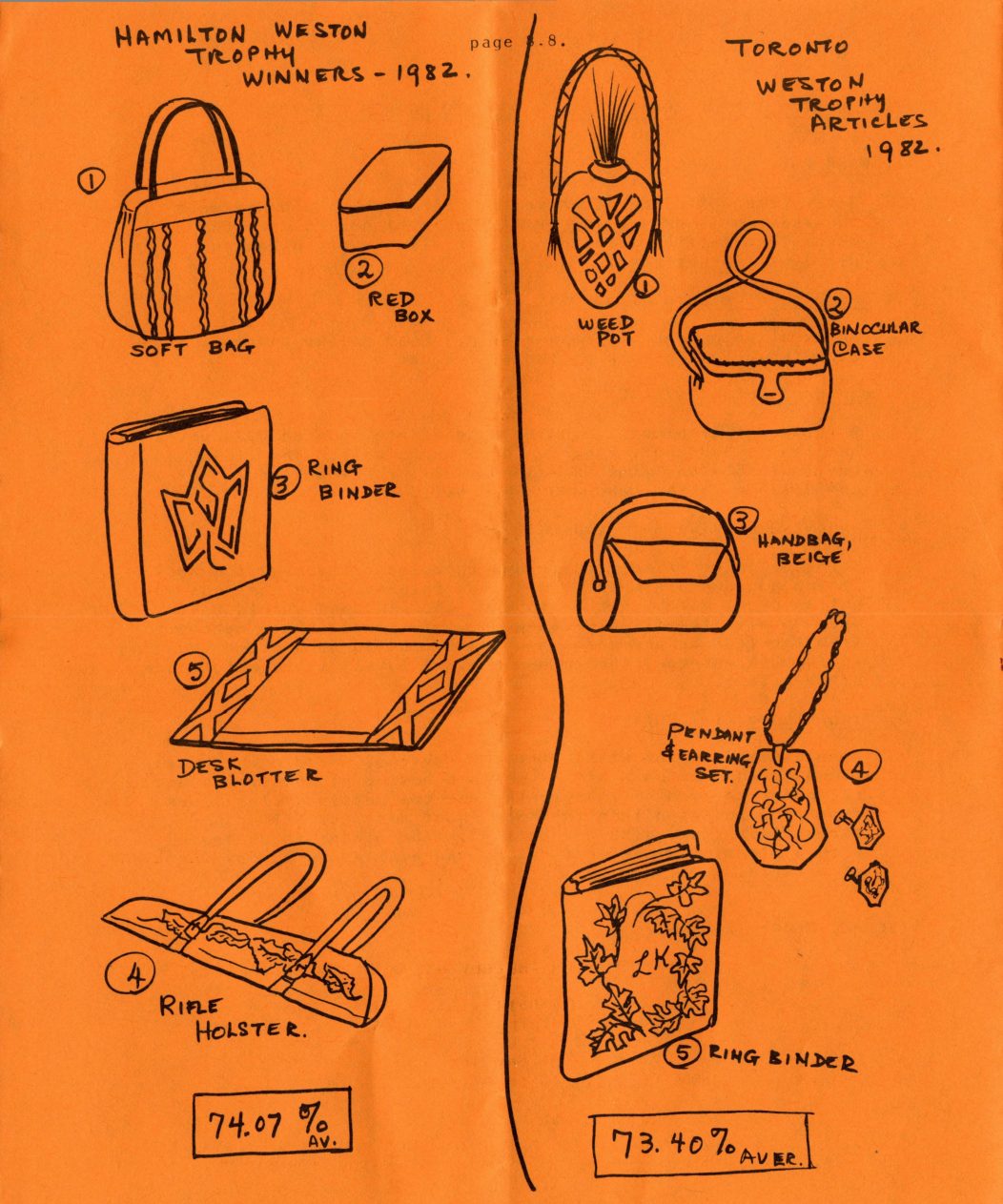
1. Soft Bag (75.72%)
This is an attractive tote bag, made of nice feeling leather. The small circles of leather inside finish off the braid ends. Perhaps the lacing could have been softened a bit before braiding into the bag. The interfacing is well-skived and the edges come together very well. 2. Red Box (79.28%)
The top fits very well, no play at all. Although the join at the back is a bit noticeable, we realize that a skived-angle join is more difficult to do than a butt join. A very lovely dye job and the edges are finished well. The inside is well boned and smooth also. 3. Ring Binder (70.72%)
The book cover is sized properly with the pages of the bulletins inside equal distance from edges. The design seems a bit overwhelming for the size of the book, and could have been a little smaller, or perhaps the shield could have been removed and just the letters C.S.C.L. used alone. This is an instance where the spaces left undecorated are as important as the space used in the design. A bit more skiving could have been done on the exterior leather on the turned edges as it leaves a ridge under the skiver liner inside the cover. The covers lie nice and flat with no bowing or dips. The pockets turned edges are done well. The ring binder itself is nicely set in.
4, Rifle Holster (68.21%)
The weight of the leather is very appropriate for the project as it will be able to take very rugged use. The saddle stitching is beautifully executed. It might have been recessed slightly to eliminate wearing of the thread. A rugged design for a utilitarian article. The decorative cuts cuts could have been improved by conturing more to the design. The strapping is well done and we find the project very suitable for the intended purpose. 5. Desk Blotter (76.43%)
3-D decoration has been fairly well done, although there are a few surface marks that do catch the eye. The design is perhaps a bit busy, but that could be a personal preference. The skiver lining has been well applied and the piece lies flat. A pleasing desk accessory.
AVERAGE MARK: 74.07% Submitted by Helen Wheaton,
Chairman of Fellows.
Page 7 — 1982 WESTON TROPHY COMMENTARY - TORONTO BRANCH ENTRY
1982 WESTON TROPHY COMMENTARY- TORONTO BRANCH ENTRY
1. Weed Pot — (81.00%)
A very elegant piece with exciting dye work. Note how well the skiving is done. The front lip is higher to keep the weeds from falling forward. All in all, a very pleasing piece of leather work. 2. Red Binocular Case (75.00%)
An excellent piece of leather work. Good colour and well executed. Take a look at the stitching. 3. Handbag, Beige (76.00%)
A very nice evening size. The handles are mounted by a novel hanging method and the hidden dome works well. The Lining is very suitable and also incorporates a turned-back edge. It is comfortable in the hand and hangs well. 4. Pendant & Earring Set (58.00%)
Using an interesting crinkle dye technique, although the back lining edges could have been skived thinner. The earrings are not an exact match to the shape of the pin, and should have been to give the illusion of a set. The metal chain detracts from the leather and perhaps a leather braid or knotted thonging would have enhanced the appearance. A lovely light weight set of jewellery. 5. Ring Binder (77.00%)
A beautiful dye job with excellent carving. We did wonder why round holes were used at the top and bottom of the lining and slits for the rest of the lining and the outside? The pages should be recessed from the edge equal distance all around three sides (top, side and bottom). The binder is decorated with a pleasing maple leaf design and will prove a very functional article.
AVERAGE MARK: 73.40%
Submitted by Helen Wheaton,
Chairman of Fellows.
Page 8
HAMILTON WESTON TROPHY WINNERS - 1982.
TORONTO WESTON TROPHY ARTICLES 1982.
[This page is a sketch plate of the 1982 Weston Trophy branch entries — page 8: Hamilton's five pieces (Soft Bag, Red Box, Ring Binder, Rifle Holster, Desk Blotter, average 74.07%) on the left, and Toronto's five (Weed Pot, Binocular Case, Beige Handbag, Pendant & Earring Set, Ring Binder monogrammed "LK", average 73.40%) on the right. No individual makers are named on this page.]
Page 9 — WHO'S WHO IN LEATHERCRAFT: MRS. GERTRUDE B. HILDER
WHO'S WHO IN LEATHERCRAFT - by Helen Wheaton,
Chairman, Council of Fellows
MRS. GERTRUDE B. HILDER
Associate Award- Annual Meeting - May 1st, 1982
Gertrude has been a member of C.S.C.L. for 25 years, and a practising leathercrafter for 35 years.
Gertrude is self-educated in her craft, having read books on the subject, and watching demonstrations at C.S.C.L. Annual Meetings and asking questions. She did receive instruction in glove making in 1946. Her special skills are the gloves and lacing articles.
She has taught leathercraft for Adult Education classes, and at Church Camps from 1948 to 1972.
Gertrude has contributed articles for the C.S.C.L. Sale at the C.N.E. in 1963-4-69, and demonstrated at the sale. She has competed and won awards since 1975 in Nova Scotia Provincial exhibitions, and the Atlantic Winter Fair. From 1978-1980 Gertrude won awards in C.N.E. competitions. She had four articles accepted for "Leather '80", C.S.C.L. Bieenial Exhibit, namely- Gloves, Belt, Wallet, and Plaque.
In attaining Associate standing, Gertrude should be an inspiration to all of us. She has overcome isolation and distance to reach her goal. An example of "Where's ther's a will, there's a way".
Congratulations, Gertrude.
I have also the pleasure of awarding to Gertrude the Zalitis
Pin, awarded to the Associate receiving the highest mark in 1982. This pin award was established by Janis Zalitis as an encouragement to members to try for Associate standing.
Respectfully submitted, H. Wheaton.
Chairman of Fellows.
JACK LAYTON -BELLEVILLE BRANCH
Jack Layton is a member of the Belleville Branch, known to many C.S.C.L. members, for his helpful hand at many events. Jack has had an eye operation this year, and this is the first year that he has missed attending the Annual Meeting. His address is: 250 Bleecker Ave., K8N 3V2. You were much missed, Jack!
Page 10 — LIFE MEMBERSHIPS
LIFE MEMBERSHIPS
Presented at the Annual Meeting, May 1st, 1982, in Toronto.
Mrs.Jessie Little is a long time member of the C.S.C.L.
She achieved her Associate standing in 1957 and her Fellowship in 1972.
She has been on the
Executive Council for C.S.C.L. for a good many years. She helped set up the Larmour Library and was Librarian for quite a while.
She teaches leathercraft, and has given many workshops and demonstrations at the Annuals and Internationals, also at many of the Guild meetings of the Branches.
She has won many awards and ribbons for her beautiful work, especially for her flowers and her lovely work in colour.
Jessie is a great asset to the C.S.C.L.
Mrs. Dorothy Muma has been with the C.S.C.L. since almost the beginning of the Society.
She achieved her Associate standing in 1954 and her Fellowship in 1955.
Dorothy and her husband Bob taught leathercraft in their own home for a long time.
She has opened their home for Executive meetings in the past, also for use by the Fellows for Judging, also accepting articles for the Toronto Exhibition and Judging for the Annuals and Biennials. For many years, they allowed C.S.C.L. to store their props etc. until they moved from 118 Hazelton Ave. recently.
Dorothy is also an excellent Craftsman. She also helped in the judging of the Biennial show entries in 1980.
She has been a great help to C.S.C.L.
Mrs. Helen Wheaton is a long time member of the C.S.C.L. She achieved her Associate standing in 1954 and her Fellow in 1965.
Helen has taught leathercraft and many other crafts in the London area. She is an excellent Craftsman in all kinds of crafts. Helen has demonstrated many times at C.S.C.L. Annuals, and also at the Internationals. She has won many prizes and ribbons.
She has helped many times during the years in setting up the show at the Toronto Exhibition, and the shows at the Biennials Exhibitions.
She was in charge of Crafts for the Western Exhibition held each year in London, for a number of years.
She has been Chairman of the Fellows, and is a past President of the C.S.C.L.
She has worked hard for the C.S.C.L., and has been a great asset to our Society.
Page 11 — GLOVE ETIQUETTE
GLOVE ETIQUETTE by Margaret LaChapelle
There was a time when a lady's attire was not complete if she was not wearing gloves. She was not seen in public without gloves, but today there are many places where gloves are not expected to be worn and where they are not needed. However, it is expected that gloves should be worn when you are in large cities, public places, to church and in church, weddings, funerals, formal luncheons, dinners, receptions, theatres and concerts.
Once you are inside, you may remove your gloves, except at formal dances and receptions. When sitting down to eat, gloves are removed entirely. It has been said that gloves may be left on when holding a drink or a cigarette, but I would prefer to remove mine in case of a stain, however, either way is acceptable.
Now we get to which gloves are worn for what. Today gloves can be made of either leather or fabric, for just about any occasion- for formal wear or late afternoon going into the evening- when you might be wearing three-quarter to elbow length. I, myself, prefer fine kid, suede and fine doeskin, but today there are also nylon and silk jersey. For daytime wear, we get into leathers of doeskin, suede, kid, chamois, and fabrics such as Egyptian double woven cotton, string, and wool jersey. For driving, we get into pigskins, (when available), African calf, deerskin, sheepskin, lined or unlined, woollen, and woollen with leather palms.
Wearing jewellery over gloves has been frowned on - a particular "No" where rings are concerned; regarding bracelets, some say "Yes" and others say "No". I'd say it depended on the occasion and what length gloves you were wearing whether or not you wished to add bracelets.
We are going to take a look at the different lengths of gloves for different occasions. For formal wear, such as weddings, theatre or banquets, where you would wear a long gown with bare arms, there are really only two lengths to consider-.opera length (middle of upper arm) or the above elbow length. At other times you can pretty well use your own judgment. You are usually safe if your glove reaches the sleeve of your dress or coat. If you are wearing a three-quarter length sleeve, your glove could meet it. If your arms are pleasing looking, you should be able to wear shorter or bracelet length- but try not to leave a long space between your glove and sleeve edge. It gives a poor appearance to your wearing apparel, whether street wear, afternoon or evening.
Here is a question that has arisen quite often. "Should you remove gloves to shake hands?" At no time does a lady remove her gloves. If you are in a receiving Line and you have taken them off earlier, do put them back on before shaking hands. A gentleman shaking hands with a lady should remove his right glove if convenient; if not, shake hands anyway. Don't try apologizing- that can become awkward.
Another question I have heard asked: "What kind of gloves does a bride wear, and is it necessary that she wear any?" At a formal wedding she should, but is not obliged to. If she does, they should be fine kid or fine suede, or sometimes, nylon. If the sleeves are long, she need only wear wrist length; if short sleeves, then to the elbow or just above. If at all possible try to rip seam of ring finger and
Page 12
slip material inside so ring can go on easily. If it's an informal wedding, the bride definitely wears gloves, either fine leather or fabric.
"What is a one-button, two-button glove, etc?" The answer to this question I found in an article written years ago, which goes on to say that you will often hear terms like these. although you'll rarely see buttons on gloves except as decoration. The terms refer to the time when buttons were used as fastenings. Today they are simply a measurement of length. Starting from the base of the thumb, a one-button glove measures one inch from the thumb; a two-button, two inches, and so on. Here in terms of "buttons" are the most popular glove lengths: shorty, or wrist length: two-button,bracelet length; four-button,mid arm; eight-button, crush; ten-button, elbow; twelve-button, opera; sixteen-button, shoulder and twenty-button.
CARRYING CASE FOR BIRD BOOK - Patterns by Clara Cavanagh.
| "A | PATTERN B |
| PATTERN oe | GRAIN SIDE |
| open | |
| PATTERN "Cc" PATTERN "D" GRMN SIDE — Grain SIDE | PATTERN E |
Page 13 — CARRYING CASE FOR BIRD BOOK
CARRYING CASE FOR BIRD BOOK - by Clara Cavanagh
Bird book measures 7 1/2 " X 10 1/8"
Materials Required:
Exterior Leather: 3 oz. cowhide, or.chrome tanned leather of similar weight.
Lining Leather +: skiver leather
Stiffener: X-Ray plate
Lacing or thread for saddle-stitching, pen, leather cement.
Patterns, *A.B.C.D.E, and P.
Quantities Required:
Exterior Leather: Cut pattern A 8" X 16 1/4" " " B 8" X 9 1/4" " " C 8" X 7 1/2" " " D 8" X 7 1/2" also in exterior leather - 3 pieces: 2 pieces 3/4" X 5 1/4"(facing)
1 piece 4" X 4 1/4" (for pen)
Skiver Lining size 8" X 8 1/4"
X-Ray plate - 1 of pattern C, one of D and one of E.
Method: How to Shape Handle -
See Pattern "A". On flesh side, at one end of "A", mark R & S 3 1/4" from end of leather. Join R & S. Place an 8" plate on the leather so it touches R.V.S. Draw a line around outside of plate passing through R.V.S. Cut away corners.
Inside of Handle -
On line RS, draw 1 1/2" in from R & S to T & U, also mark point W one inch from point V. Join T, W, and U, following curve of R.V.S. Cut out inside of handle. Form handle on pieces B.C. & D in the same manner.
Turnback for Top of PocketAt opposite end of leather from handle, on flesh side mark a line F.G. one inch from end edge M.N. Gouge this line, then skive M.N. Dampen gouged line F.G. fold over, and cement down.
Bottom of Case -
Draw a line H.I. five inches from F.G. Then draw K.L. one inch from H.I. This area (H.I.L.K.) is the bottom of the case. Gouge lines H.I. & L.K. Dampen gouged lines and form into case shape.
Page 14 — LIPSTICK CADDY
Skive -
(1) The edges marked [a row of drawn hatch marks] on A & B. (Exterior leather) (2) One edge on flesh side of each 3/4" X 51/2" piece(Ext. Leather)
Pen Holder -
Sew pen holder to leather piece "C", 1/2" from bottom of handle. (See sketch C)
Edge CreaseAs shown on sketch C and D
Design -
Can go on area K.L. and R.S. on grain side of leather.
Assembly-
(1) Cement skived edges of A to skived edges of B. (see patterns) making sure that A is one inch below R.S. on B. Exterior of case is now in one piece.
(2) Cement X-Ray plate C. & D to flesh side of leather pieces(exterior leather) and cement X-Ray plate piece E to bottom area. (3) Cement lining to X-Ray plate as shown in sketch P.
(4) Cement facing pieces to lining as shown in sketch P. (5) Join exterior leather of C & D to case by cementing edges together. Leave creased edges on C. & C & D free. Do NOT cement down.
(6) Lace or saddle-stitch around inside of handles and around case. (7) Polish with suitable protection coat.
LIPSTICK CADDY - by Vera Farrara
Cement together 3 sole wight leather
3 1/2" diameter rounders (circles).
Secure and drill required size and number of holes.
Burnish edges. Dye.
Mount and cement to 4th rounder. Finish.
Cover or dye post and cement into hole the size of the post.
A base can be made that is larger, such as a covered small plate, and the caddy can be mounted onto this.
Page 15 — TIPS & HINTS for the WORKSHOP
TIPS & HINTS for the WORKSHOP
1. Leather will stretch more across the skin from flank to flank than it will from neck to tail. Use this stretching to advantage when making gloves.
2. If you use shears to cut leather, lightly coat the blade edges with candle wax that you have softened by heating. The waxed edges will grip the leather and keep it from slipping. If you don't wish to heat the wax, cut through an old candle stub and the wax will coat the edges of the shears.
3. To cut leather fringe, put rubber cement on a large piece of cardboard, let it dry, then place the leather to be cut for fringe on the cemented cardboard to prevent it from slipping. Using a sharp knife and a straight edge, cut fringe as narrow as you please.
by Margaret Hunt
1. A piece of styrofoam is ideal for shaping a flower or centre. Push a pencil end into styrofoam to shape your flower, using pins to hold the petals up in shape while the leather is drying. Shape centres and allow to dry in the same manner. Punch a centre hole and push down with a large headed pin. Use over again when needed.
2. Use caps off spray paint bottles to set your dye in.... also these make good containers for cleaning brushes.
by Vera Farrara
1. For using up skiver leftovers:
Cover buttons, make pin-back reinforcements, use as contrasting seams or decorative accents on leather-covered bottles. (e.g. small maple leaves could be cut out, dyed, and adhered in a spray pattern to the surface of the bottle.) The smallest pieces can be used for notepaper decoration, in the form of leaves, mushrooms, birds, monograms, etc. Also use as a skiver backing for filagree work. You can use scraps for covering pendant shapes for jewellery or cufflinks. Small bottles (such as spice jars), can be decorated with scraps, also 2 oz. lavouring extract bottles.
If you have a large piece of it left, you could of course line a wallet or change purse or keycase, but generally we are too "thrifty" in laying out our original patterns to have scraps this large left over!
by Carol McLean
Dye work on flowers is a messy job, trying to handle all those small pieces, so remember to buy a pair of angled "soldering tip" tweezers for picking up and dipping centres and petals in dye. I transfer small quantities of dye to margarine containers, (small size), and dip the whole flower sections directly in it, then set it on newspaper to remove excess. This may waste dye, but saves one from strange-coloured fingers! I use surgical rubber gloves when working with dyes, and they are the most flexible and easy to use when dyeing flowers,
M. Patterson
Page 16
DATES TO REMEMBER ..... SPECIAL UPCOMING EVENTS
LEATHER '82: A SPECIAL INVITATION TO ALL MEMBERS & FRIENDS
Grand Opening of Leather '82 to be held Friday, July 2nd ** 7:30 p.m. At: The Gallery - City of Brampton Public Library and Art Gallery, 150 Central Park Drive, Bramalea, Ontario. ** Please note that Opening has been moved from July 1st to July 2nd We hope that you can all be present for the opening of our Biennial Exhibition, and we invite all friends to attend, to make this a really big event! For more details on directions for travelling to the Gallery, please consult your Branch President who has been mailed a map. Members-at-large may consult Jean Hunter, Show Convenor, at 1-416-846-1217, or write her at Snelgrove, Ont. L0P 1M0.
C.N.E. 1982 Please help out our Work Schedule Organizer, Hope Drysdale, by contacting her to pledge a day at the C.N.E. Sales Booth, C.S.C.L. Hope may be reached at: 130 Young Street, Hamilton, Ont. Many dates already filled, but we solicit YOUR help to finish filling the schedule!
This page's running head ("16.") and the two headings and two notices below it had each printed line rendered as its own single-cell table row; reset here as the page's own headings and paragraphs. The postal code for Snelgrove, Ont. is set here with zeros, as "L0P 1M0". On this page the typed capital O and the zero look alike, so the page itself does not settle which was typed.
HELP! We need a volunteer for the post of Treasurer at our C.N.E. Sale.... please contact C.N.E. Committee Chairman, Jack Meharg, if you can help in this most needed way! Jack's address is: 36 Bailey Cresc. Scarboro. C.N.E. dates for 1982 are Wed. Aug. 18th- Mon. Sept.7. Booth "set-up" day is Tuesday August 17th, and a special mailing for your entry lists, rules etc. will be sent out soon! We need your fine crafts!!
ASSOCIATES WORKSHOP: § Saturday Sept. 18th - 1:30 p.m. This is a MUST for ALL ASSOCIATES who wish to progress to Fellow standing in the future. Bob and Dorothy Muma are kindly opening their home to the Associates, (approximately 30 are listed with our Society), for a discussion of the type and qualities of work needed for acceptance as a Fellow.
I
Bob Muma, as Teaching Standards Chairman, will be leading the discussion, and Fred Brown, as Chairman of Fellows, urges ALL Associates to take advantage of this chance to advance! Please let the Muma's know if you are planning to attend, as soon as possible at:
625 Rushton Road, Toronto, M6C 2Y8.
FALL WORKSHOP! !!!!!!! SATURDAY. NOV. 27th Ed Lautenschlauger of NORTON ABRASIVES will demonstrate SHARPENING TOOLS
Plan to attend.
["NORTON ABRASIVES" is easy to read duplicated in part ("NORTON AB i ger of NORTON ABRASIVES"); set out here as the single printed phrase.]