
The Canadian Handicrafts Guild competition at the C.N.E., 1951–1989
← The Craft · assembled from the newsletters that printed the prize lists, the winners and the judges' reports; its own C.N.E. booth traced to its disbandment via a 2005 tribute
The Guild's competition left no archive of its own in this collection. What survives is the Society's own newsletter: a prize list printed in the spring or summer issue, and the winners, the judge's remarks and the attendance in the issue after. This page is assembled from that run, 1951 to 1989. Every figure below is quoted from the issue that printed it, and the issue is named. Every person named here is published elsewhere in this archive, except the four judges and critics named in the section on the reports below.
1951: three fairs, and a count that shamed everybody
The earliest measurement the archive holds of Canadian leathercraft at a national fair is a questionnaire the Society's own editor circulated after the 1951 season and printed in the December newsletter. It counted the entries at three exhibitions: 56 at the Canadian National Exhibition, 34 at the Central Canada Exhibition in Ottawa, 20 at the Pacific National Exhibition. Of the 56 at the C.N.E., 22 were entered in original classes and about a third of those were judged genuinely original; the rest were copywork or adaptations. Workmanship was rated “average to poor, excepting certain 1st and 2nd prize winning pieces”. Asked how many entries showed a distinctively Canadian feeling, the observers answered: C.N.E. “perhaps half a dozen”, Ottawa “just several”, Vancouver “none”.
- Run by the Canadian Handicrafts Guild inside the Canadian National Exhibition — a separate competition from the C.N.E.'s own leather class, judged separately and with its own prize list
- The Society treated it from 1954 as “the show window for the best in Canadian leathercraft”; in most years almost every entry came from a member
- Largest entry recorded: 82 articles by 31 craftsmen in 1957, the first year more work was accepted than there was space to show
- No competition in 1961 — the Manufacturers Building was destroyed by fire
- Judged by outside critics, among them Marie Huper (1954), Nicholas Hornyansky (1955), Sylvia Hahn (1957), Harold J. Brennan (1960 and 1964) and Joseph Trippetti (1967)
- From the later 1960s the Society's presence became a sales booth in the Arts, Crafts and Hobbies Building — 2,245 articles approved for sale in 1969, 2,336 in 1980
- CSCL's own annual sales booth at the C.N.E. — separate from this competition — had been disbanded by 2005, when a member's tribute recalled it
The judges' one piece of praise was for a rule rather than a piece of work: the C.N.E. organisers were “to be congratulated in adopting policy of offering separate awards for ‘original’ and ‘commercial design’ entries”, and the next step recommended was that the original classes should carry the larger prizes, “as it is felt that exhibitions of national scope should attract the best possible examples of Canadian designed leathercraftsmanship”. That argument — pay more for original work than for copywork — is the argument the Society then pressed for the next fifteen years. (Winter 1951, p. 5.)
1954: the Guild's own leather classes
The competition this page is about is not the C.N.E.'s own leather class. It was run by the Canadian Handicrafts Guild inside the Exhibition, judged separately, with its own prize list and its own entry forms from the Guild's shop at 77 Bloor Street West, and the newsletter took care to say so every year: “this is an entirely different competition to the Handicrafts, Women's Division, Leather Class, C.N.E., listed in the C.N.E. Prize List.”
The Autumn 1954 report is the first the archive holds. Five first prizes were offered, each by a different donor — the Women's Committee of the Guild for the best original entry, Clarke and Clarke Leathers of Barrie for tooled or carved work, Lewis Craft Supplies for work neither tooled nor carved and again for leather gloves, and the Ottawa Valley Leathercraft Studios for the best original design carrying no more than twenty per cent decoration. Edith Roscoe took that last one for a box; Clarice Packham took the gloves; Margaret Lancaster took the undecorated class. “With one exception, all articles accepted and displayed were the work of Society members.” Anne Hook, Olivia Smith, Reta Larmour and Don MacKinnon were among those exhibited but unplaced.
Final judging was done by Miss Marie Huper, Professor of Art at Agnes Scott College in Georgia. Pearl McCarthy, art critic of the Globe and Mail, reviewed the Guild's show and gave the Society the sentence it quoted for years afterwards: “With some exceptions, the prize-winning pieces in the Guild's section are much better taste than those in the general C.N.E. section. The Guild's leather section should be especially noted by workers in this craft, as it cuts away from the overly ornate fancy work. The box by Edith Roscoe of Weston and a purse by Reta Larmour are very good.” Reta Larmour, who wrote the report, ended it by asking members to begin planning at once for next year, “in order that we may take a share in making this competition the showcase of the best in Canadian leathercraft”. (Autumn 1954, p. 6.)
The show window, 1955–1957
The phrase stuck. From 1955 the newsletter called the Guild's competition “the show window for the best in Canadian leathercraft” and treated support for it as a duty. The 1955 prize list ran to five classes and $67 — $25 for the best original entry, $10 or $12 for the rest — and the summer issue printed it in full with the entry address, noting that forms had been posted only to the members thought most likely to compete and that anyone else should write to the Guild for one. “To have your work accepted for this display will bring recognition to you as a leathercrafter, even though you do not win a prize.” (Summer 1955, p. 10.)
Every 1955 entry came from a Society member. Nicholas Hornyansky, of the Ontario College of Art, sat on the jury and “congratulated the Society on the advances made in the quality of the entries submitted”. Demonstrations were given daily through the fortnight by Reta Larmour, Don MacKinnon, Robert and Dorothy Muma and Endel Ruberg. (Autumn 1955, p. 9.)
For 1956 the list grew to eight classes. Two of the three new prizes were reserved for a craftsman who had never won at a national competition before — $15 and $10 from the Guild's Ontario branch, “designed to encourage craftsmen who have never before competed in a national competition, in the hope that it will bring in many new competitors” — and the third, $15 from the Garnett Company, went for the best use of colouring techniques. Entries were taken at the Guild shop over six days in August; there was no entry fee and carriage both ways was paid. H. E. Arnold won the first-time prize, Olivia Smith was second, Anne Hook took the most original entry, Endel Ruberg the tooled class, Robert Muma the untooled, Don MacKinnon the twenty-per-cent class, Clarice Packham the gloves and Jean Agnew the colouring prize. (Spring 1956, p. 5; Autumn 1956, p. 8.)
1957 was the high-water mark. The display moved into the new Queen Elizabeth Building, the prize list reached eight categories and $210, and a rule was added that no competitor could take more than one prize in each craft. The entry was a record: “82 articles by 31 craftsmen … made up almost entirely of Society members, as was the prize list with one exception.” For the first time there were more articles accepted than there was room to hang, and several large pieces had to be left out. Robert Muma took the $50 best-in-show from F. W. Woolworth for his binding of Native Trees of Canada in dark green morocco with a red maple leaf inlaid down the spine. Sylvia Hahn, Keeper of the Prints at the Royal Ontario Museum, sat on the jury and said the work was in places so nearly equal that choosing was difficult. (Autumn 1957, p. 5.)
1958: the money doubled and the entry collapsed
The 1958 prize list was the largest the competition ever carried. Woolworth's $50 best-entry prize stood, most classes gained a second prize, and two special awards open to every craft were added — $100 from the British American Oil Company for an outstanding entry featuring a Canadian design or motif, and $100 from Jordan Wines for the best contemporary design. No craftsman could take both. (Summer 1958, p. 10.)
The report in the autumn is the bluntest sentence the Society ever printed about itself: leather entries “were disappointingly few in number. There was little outstanding original work and it was agreed that the Society in general had fallen down on the job.” The prizes were awarded anyway — Robert Muma best in show for a plaque of the Canadian coat of arms, Olivia Smith and Clarice Packham in the carved class, Irva Ford for moulded candlesticks, Reta Larmour, Nora Huyck, Fred Brown, Gladys Miles, Anne Hook, Endel Ruberg for a desk set in fish skin — and the report ended: “It is to be hoped that members will ‘pull up their socks’ a good deal next year and really give the judges a workout.” (Autumn 1958, p. 11.)
Fire, and the year with no competition
For 1960 the Guild moved its display and demonstration stage into the enclosed part of the Queen Elizabeth Building formerly called the Kitchen Theatre — “an aim of the Guild: a display area and demonstration stage entirely separate from other exhibits” (Winter 1960, p. 8). Then in 1961 there was no competition at all. The reason is given in one line of the following spring's Annual Meeting report: “Last year there were no competitions owing to the destruction by fire of the Manufacturers building.” Competitions resumed in 1962, and the same paragraph shows the Society's attitude hardening into something less deferential: “while we have a duty to the Handicraft Guild, in the interests of good leathercraft this competition is also a place where we can make an impact” — Anne Hook believing that with effort the Society “could clear the C.N.E. Handicraft Exhibit of poor leathercraft.” (Spring 1962, p. 2.)
The 1962 prize list shows the competition working as designed and failing in one place. Endel Ruberg took best in show, $50 and the President's silver medal, for an album; Anne Hook the $35 original-approach prize for a gavel and anvil; Clara Cavanagh the moulded class; Gunars Buss and Janis Zalitis first and second in decorated leather; Sadie Roebuck and Clarice Packham first and second in undecorated. Against the first-time-winner class the page reads “$25 Not awarded”. Eleven members demonstrated that fortnight, and the report notes that more space had been given to demonstrations “which was just as well as there were more people constantly around the demonstrations than ever before” — while “many people were disappointed at the sparse showing of articles on display.” (Autumn 1962, p. 3.)
The Society knew what audience it was buying. In 1963 the Annual Meeting was told there had been “approximately 50,000 visitors at Stratford last year and as you know the C.N.E. had over 3,000,000 visitors, so these exhibitions and competitions are excellent places to bring the best of Canadian craftsmanship before the great number of people who come from the United States and Canada.” (Spring 1963, p. 2.)
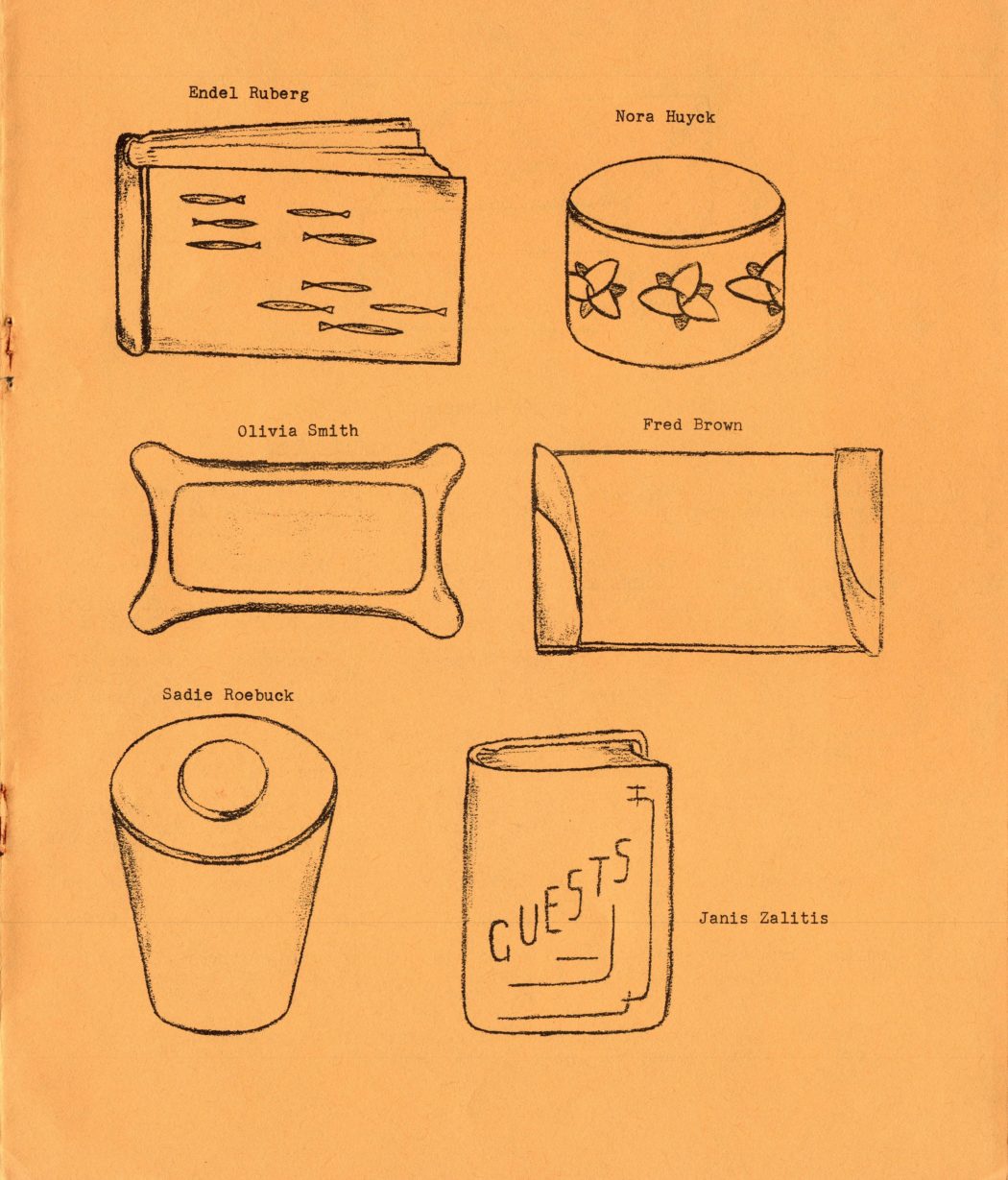
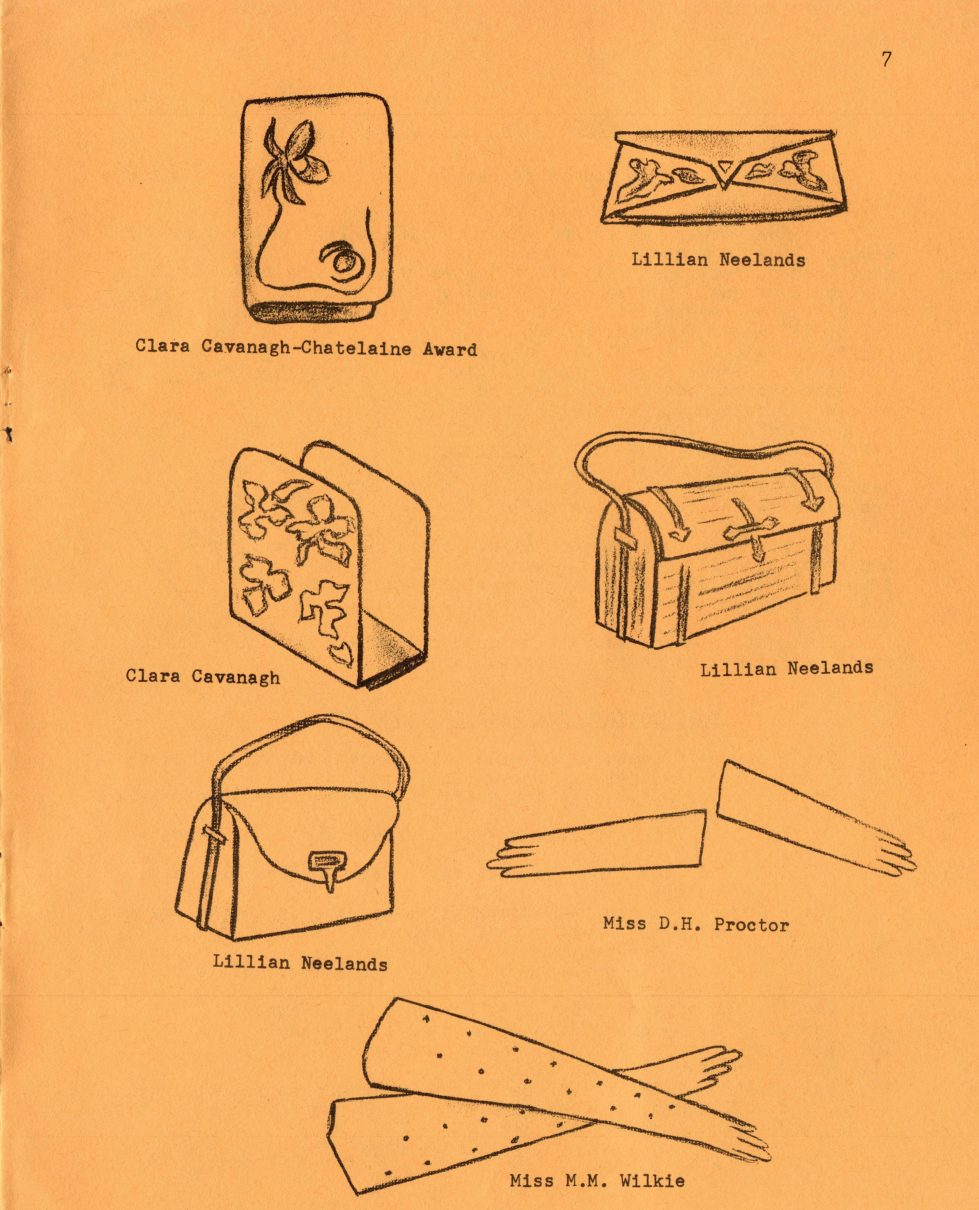
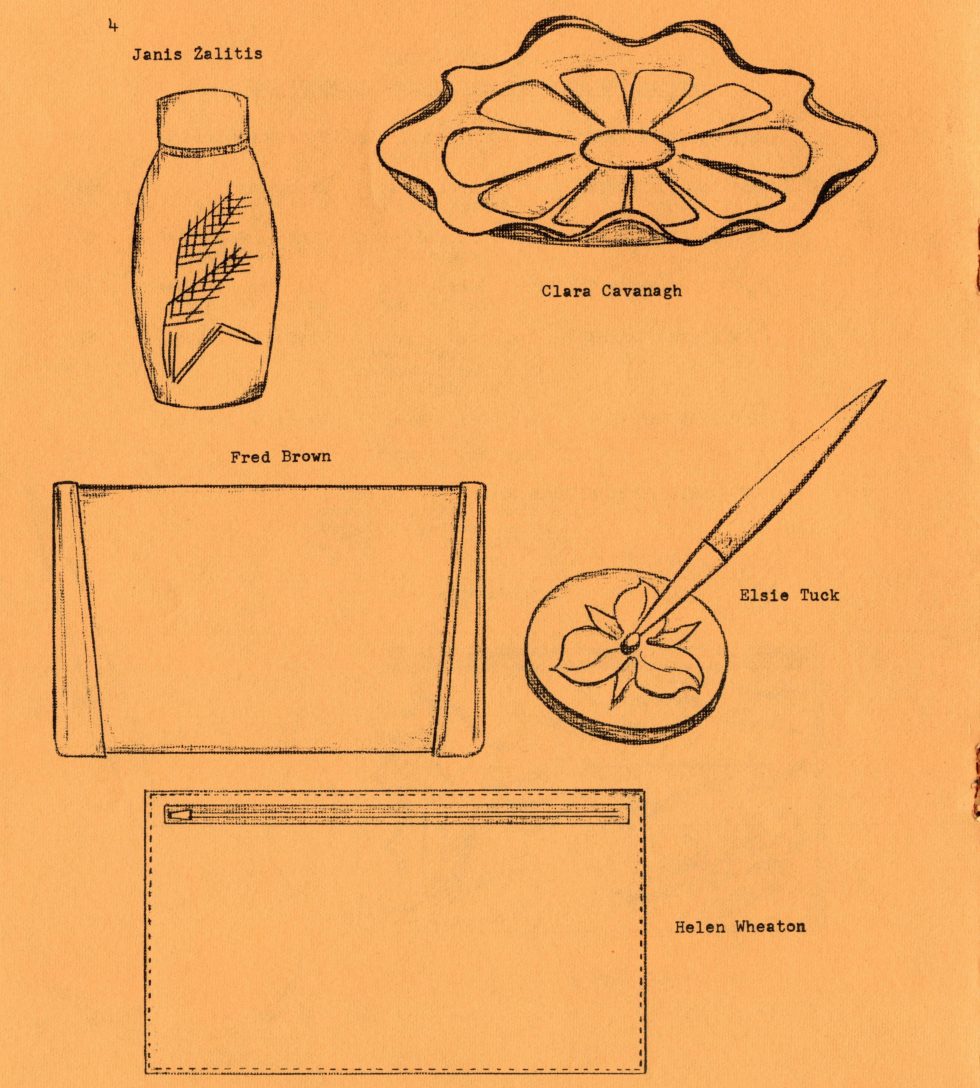
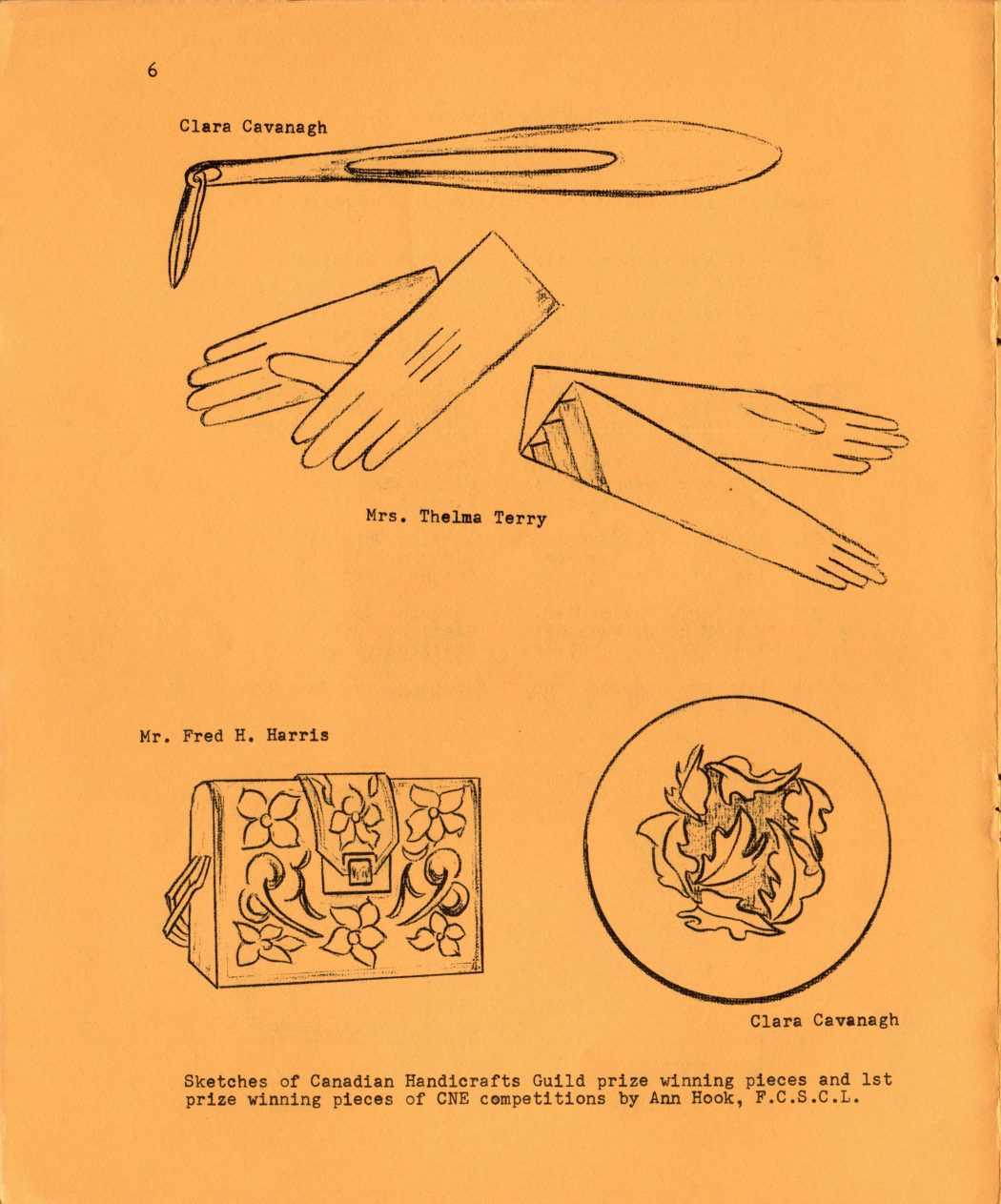
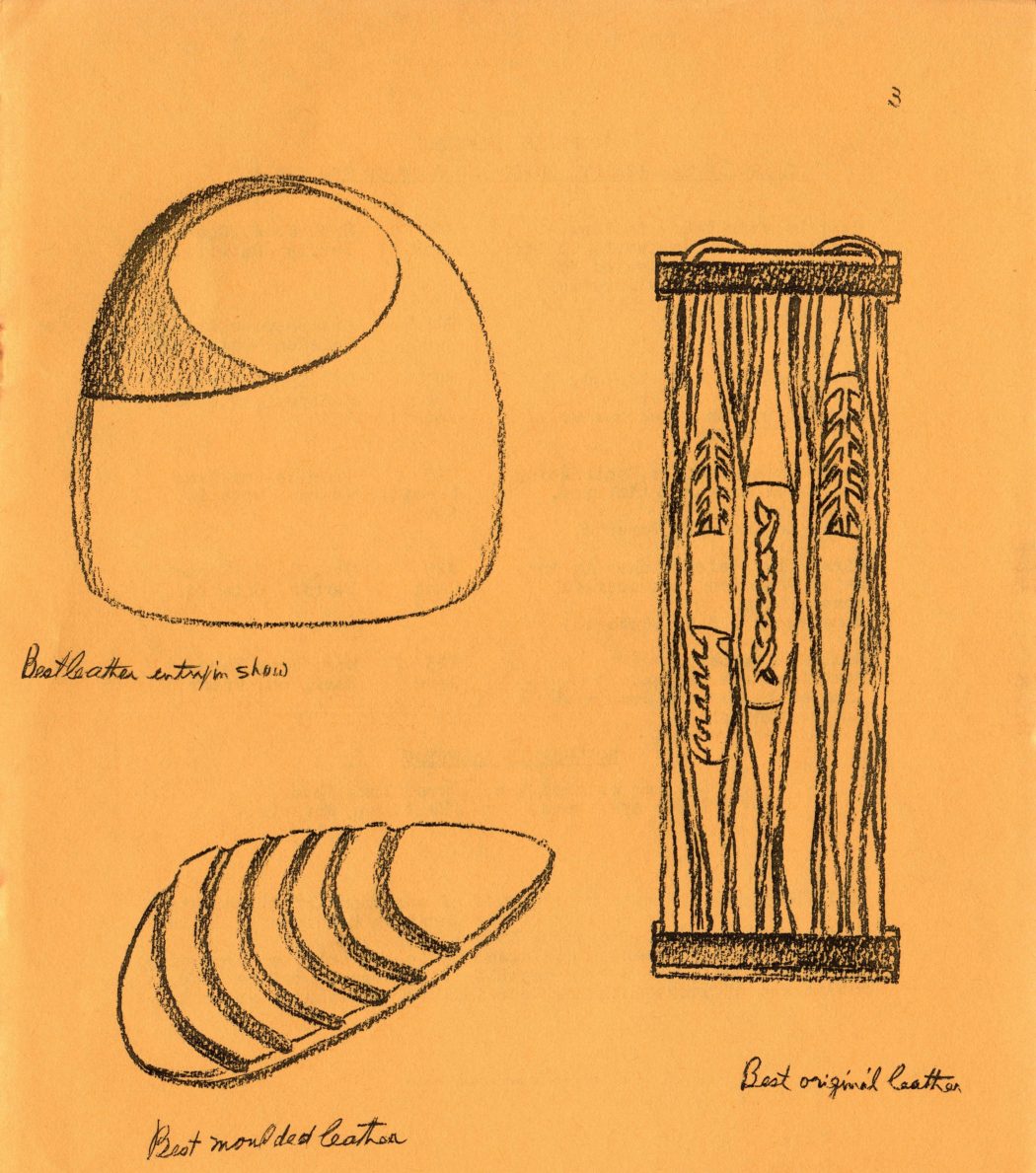
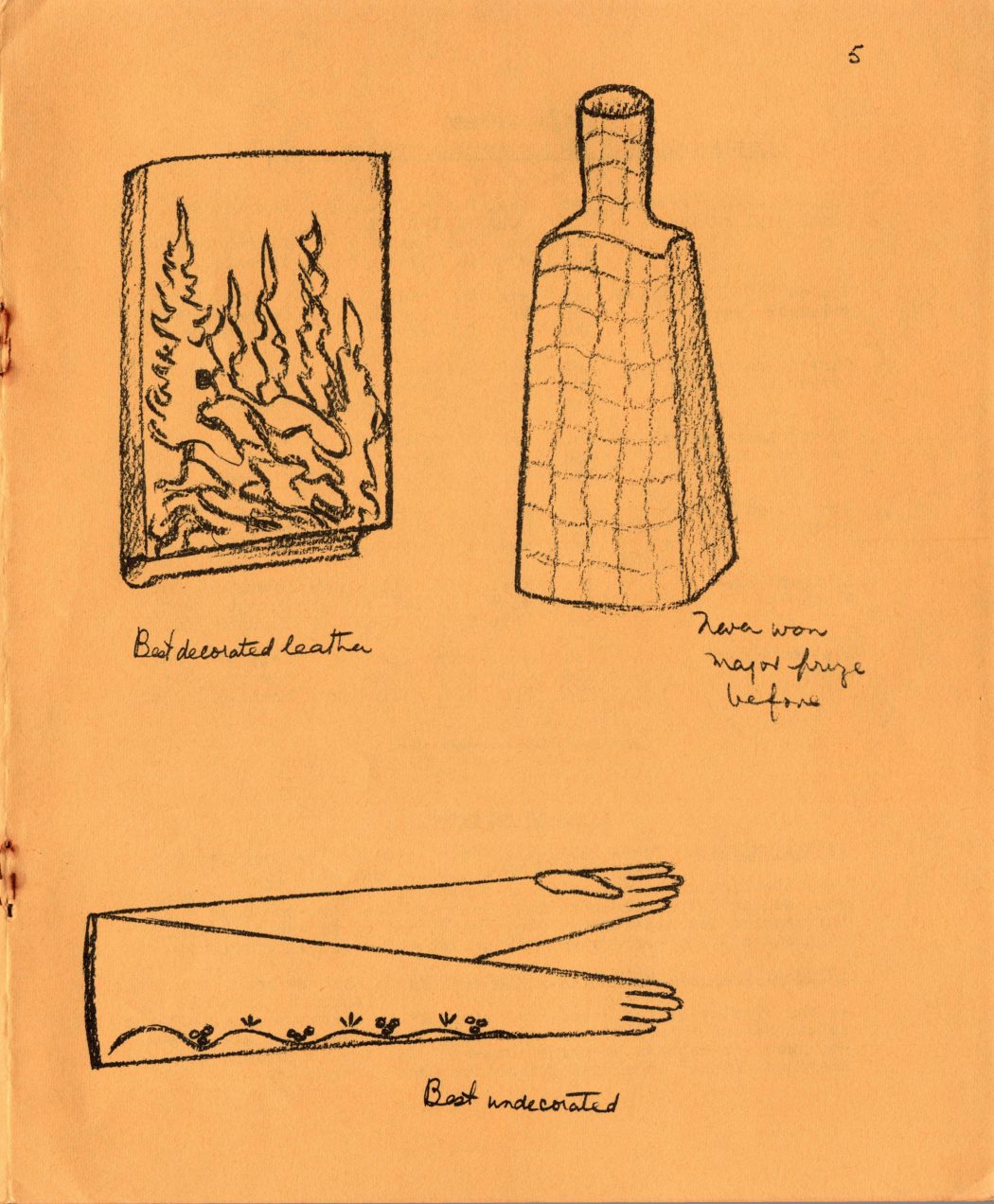
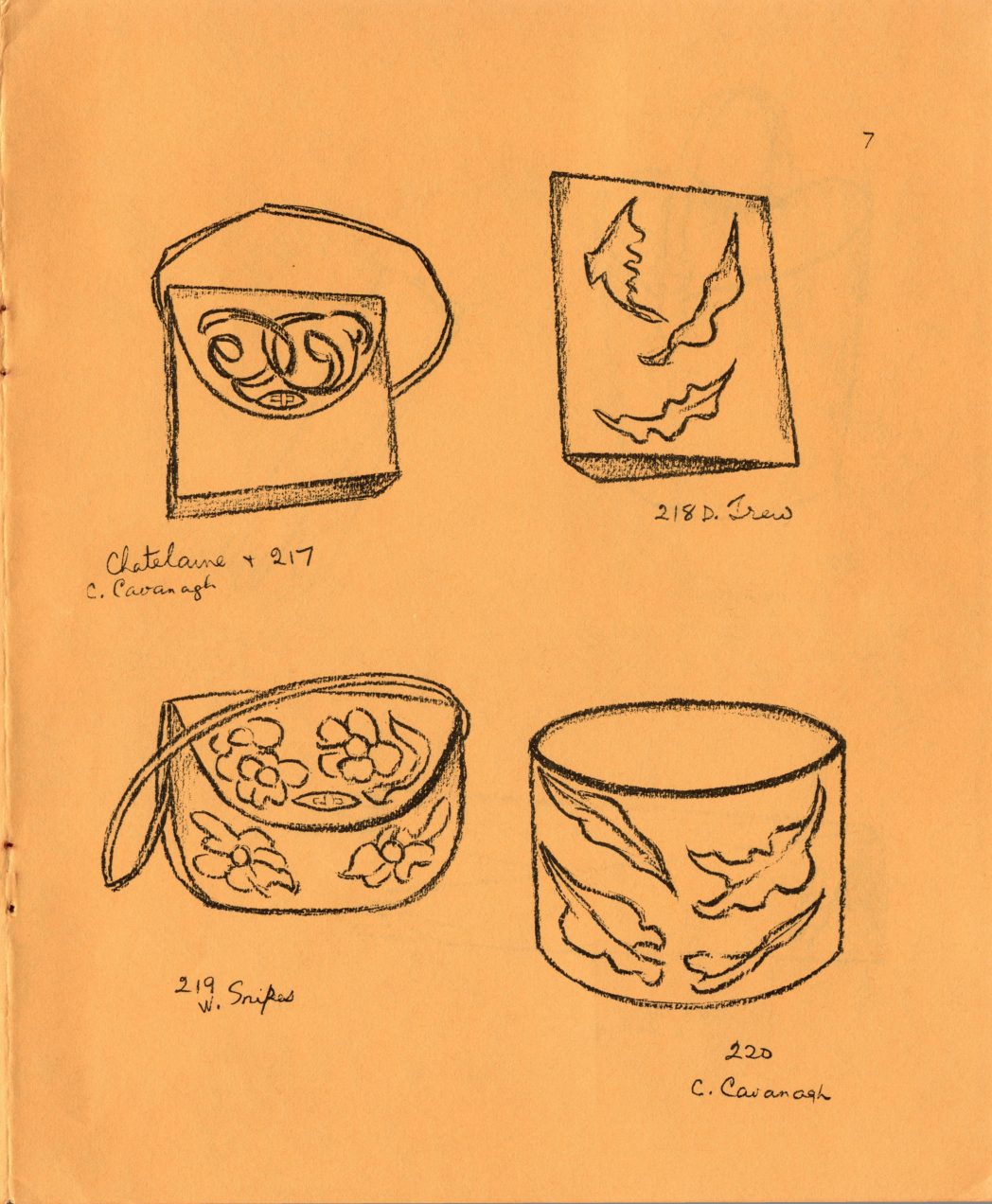
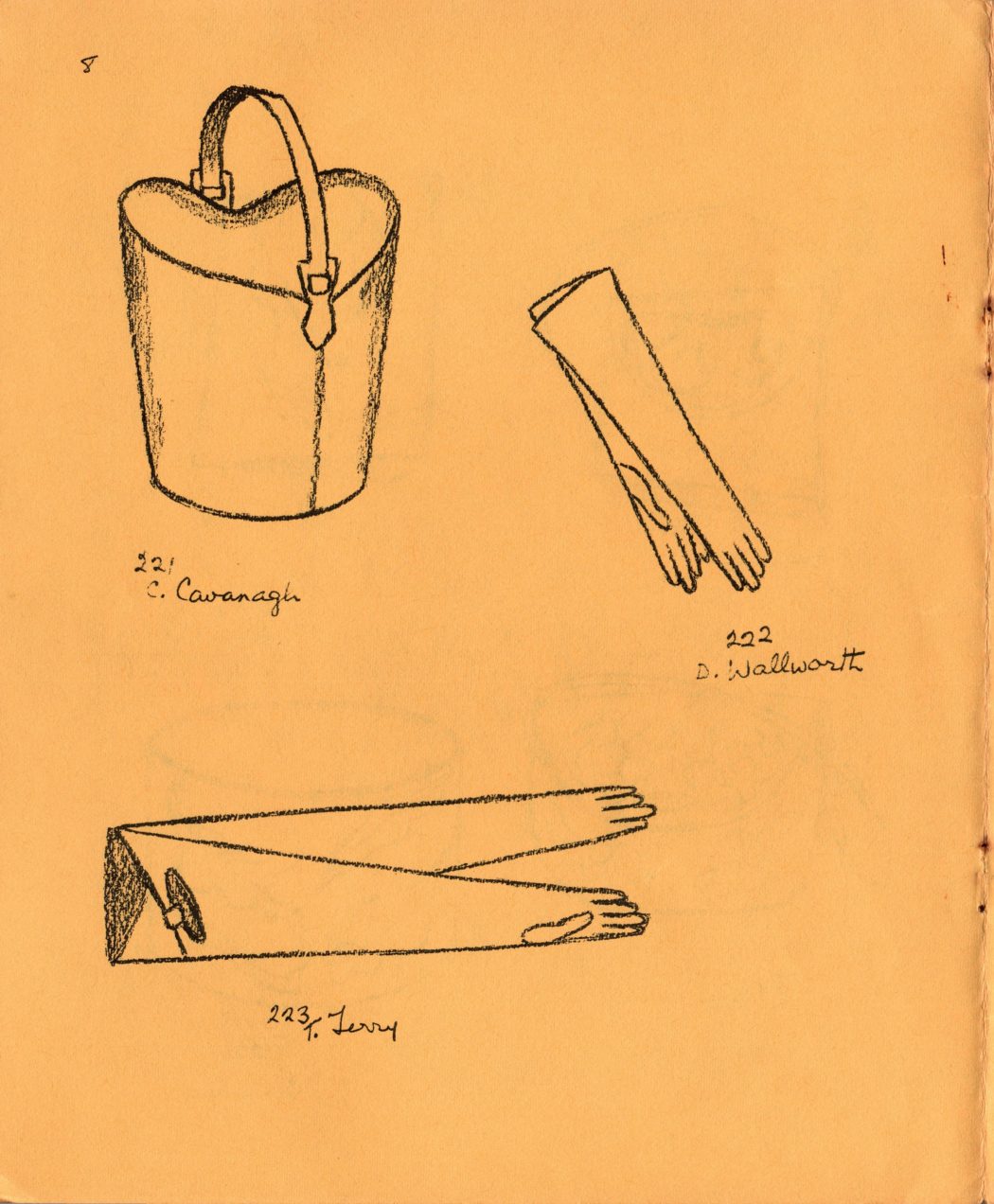
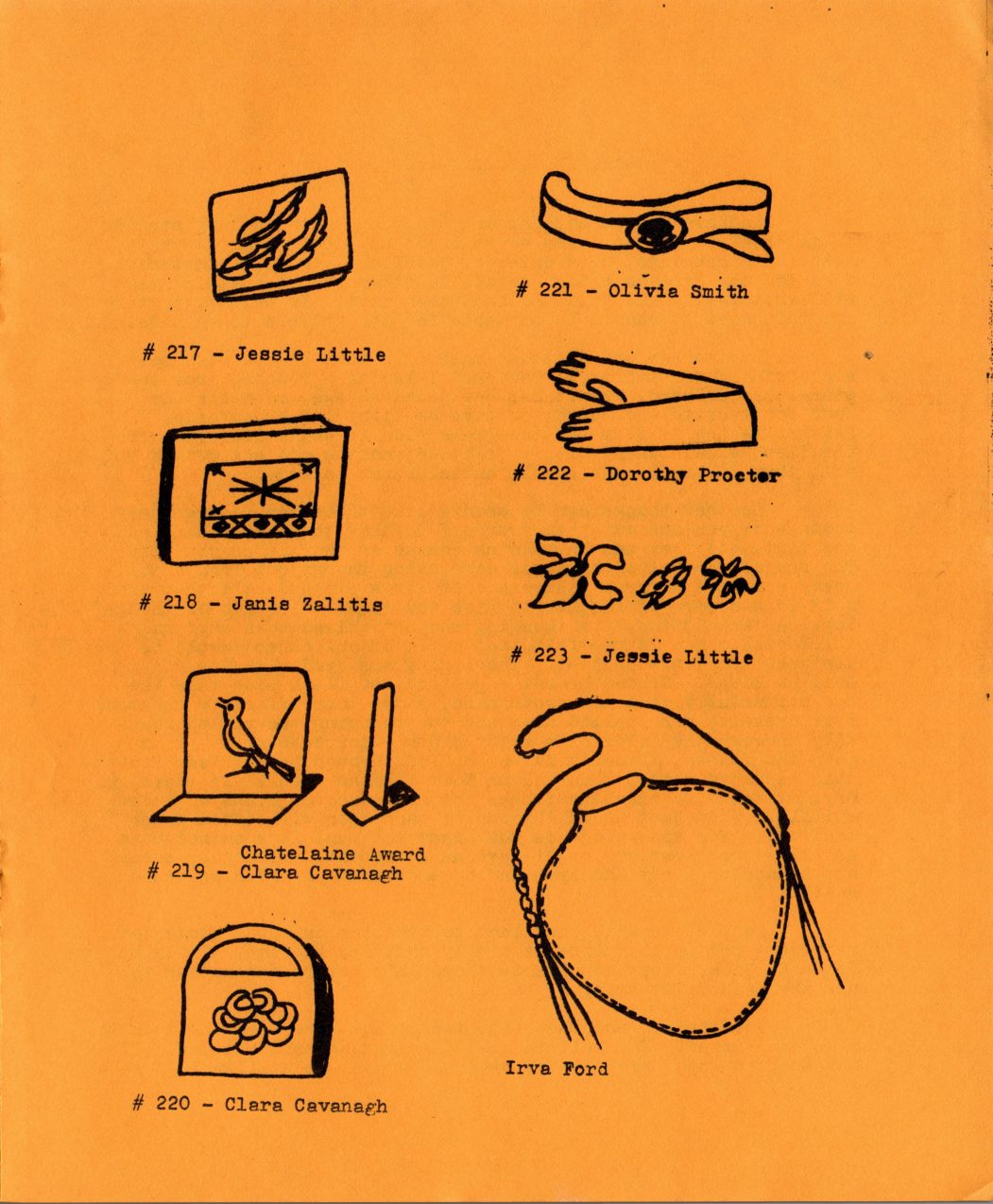
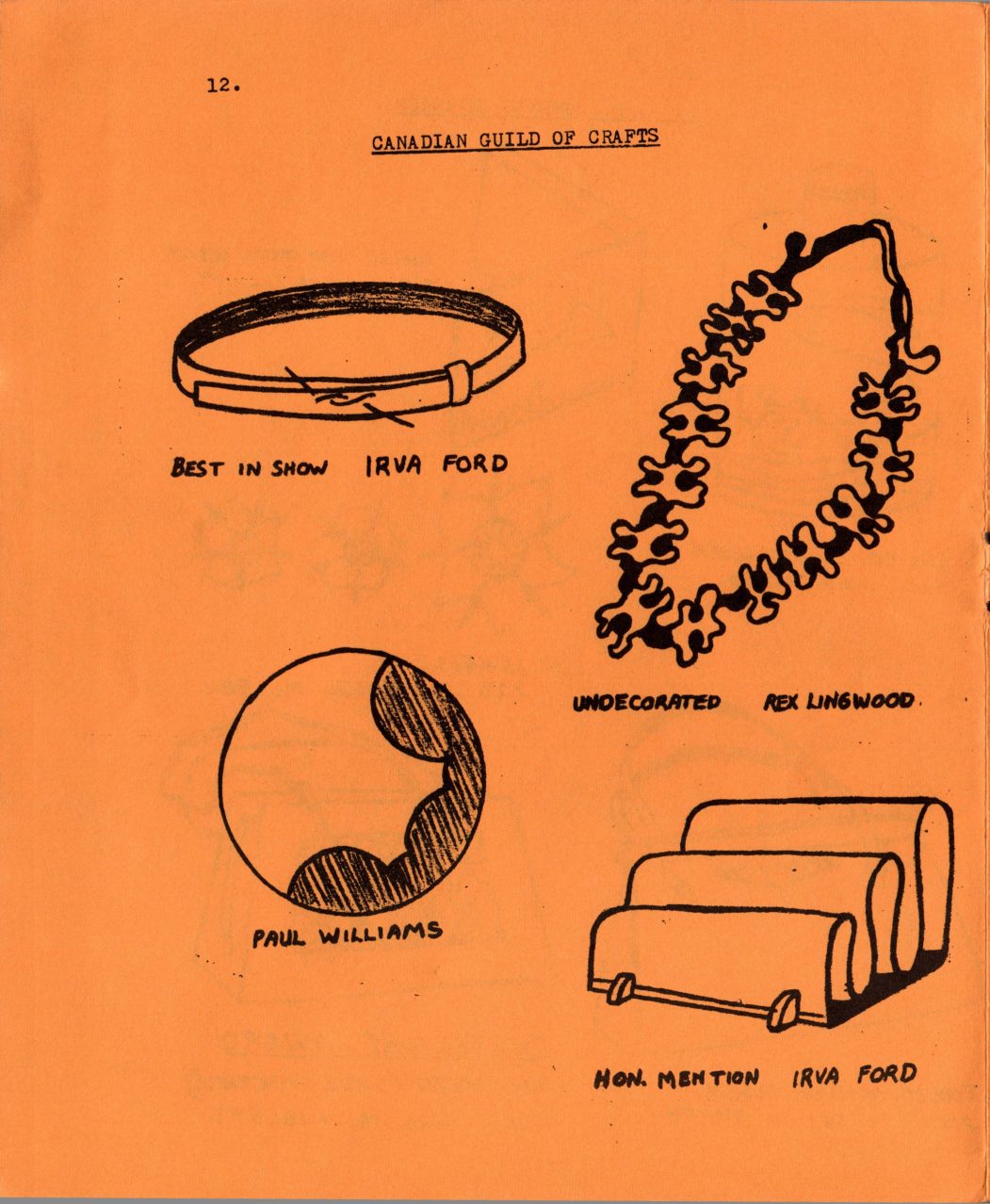
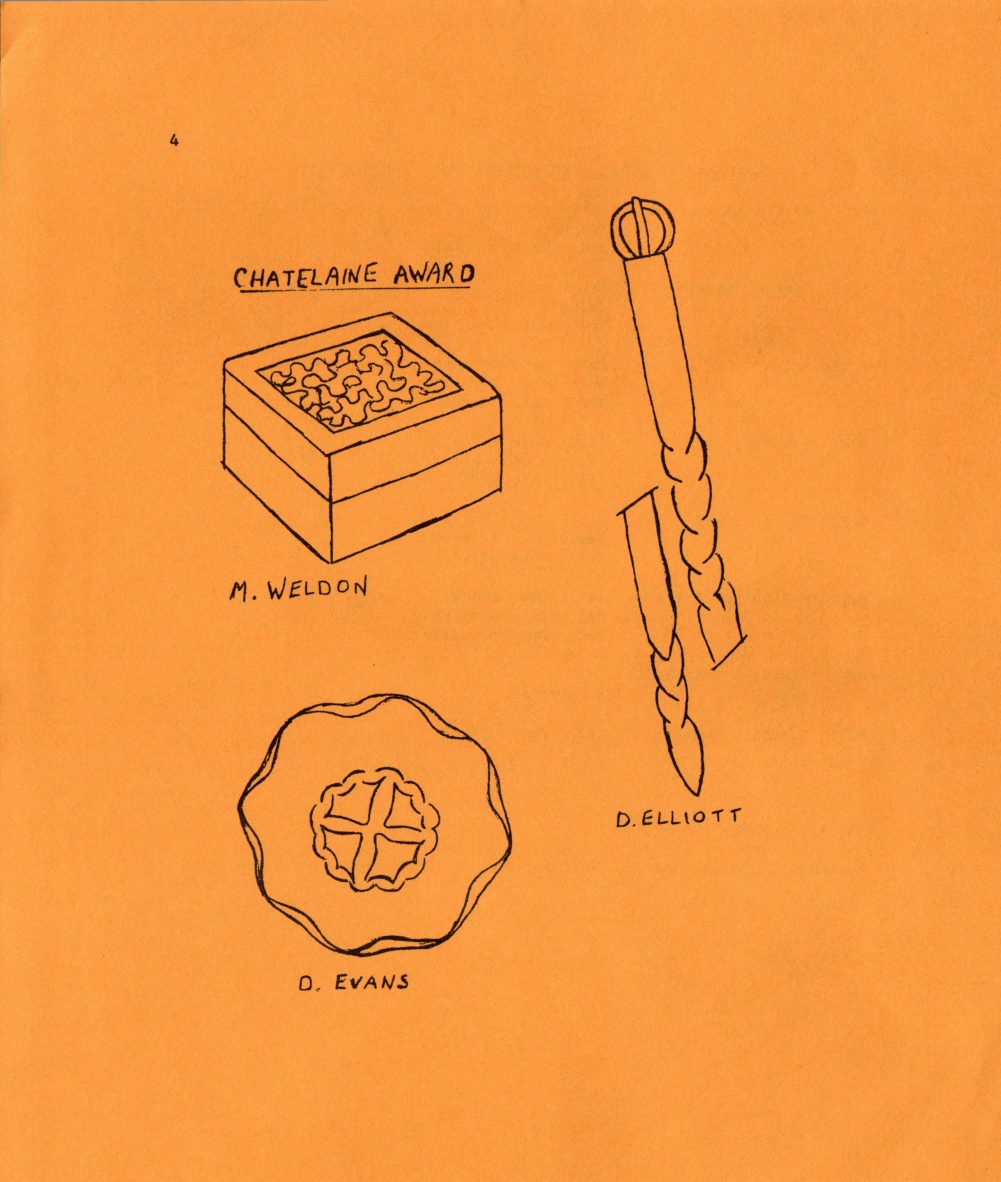
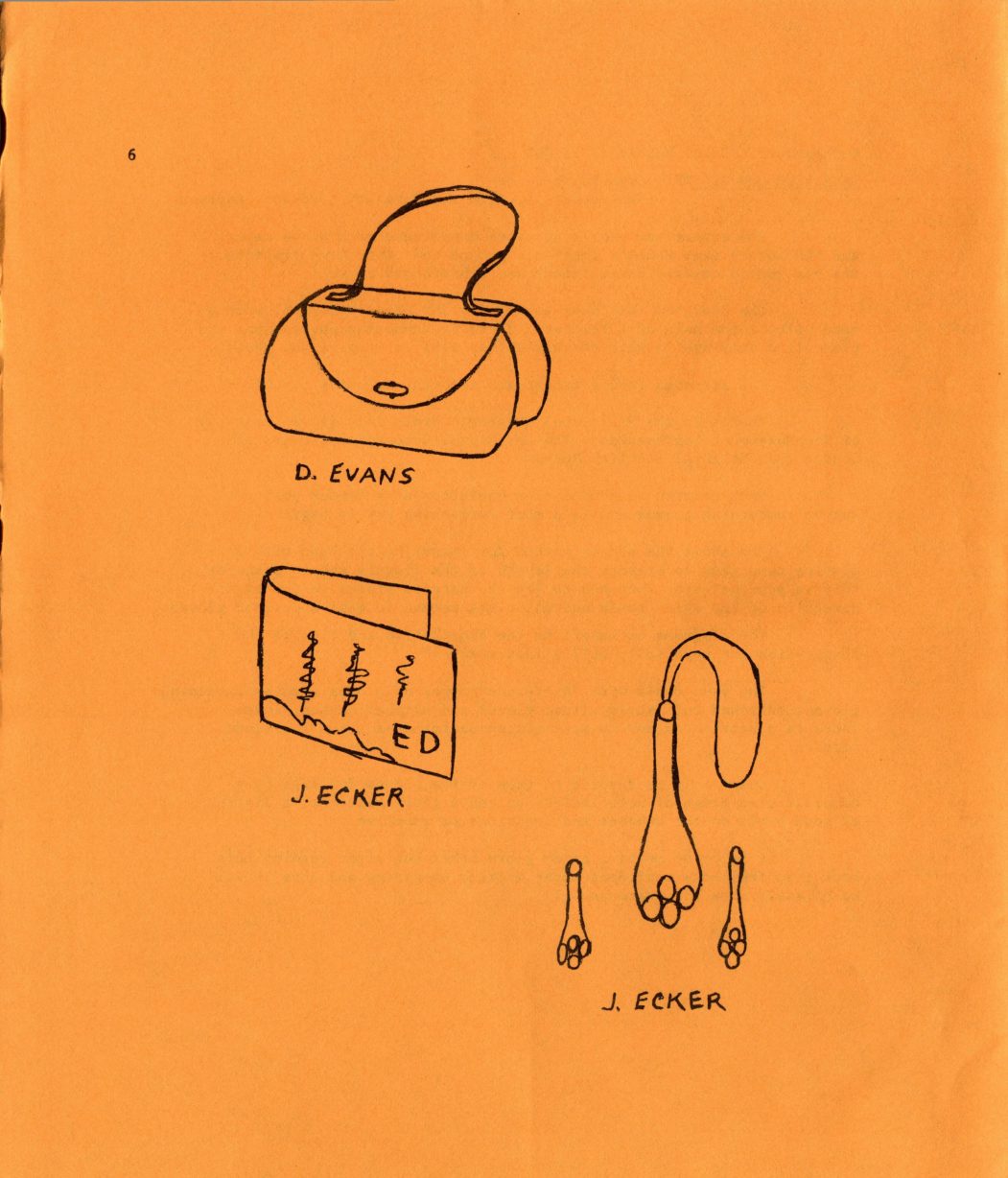
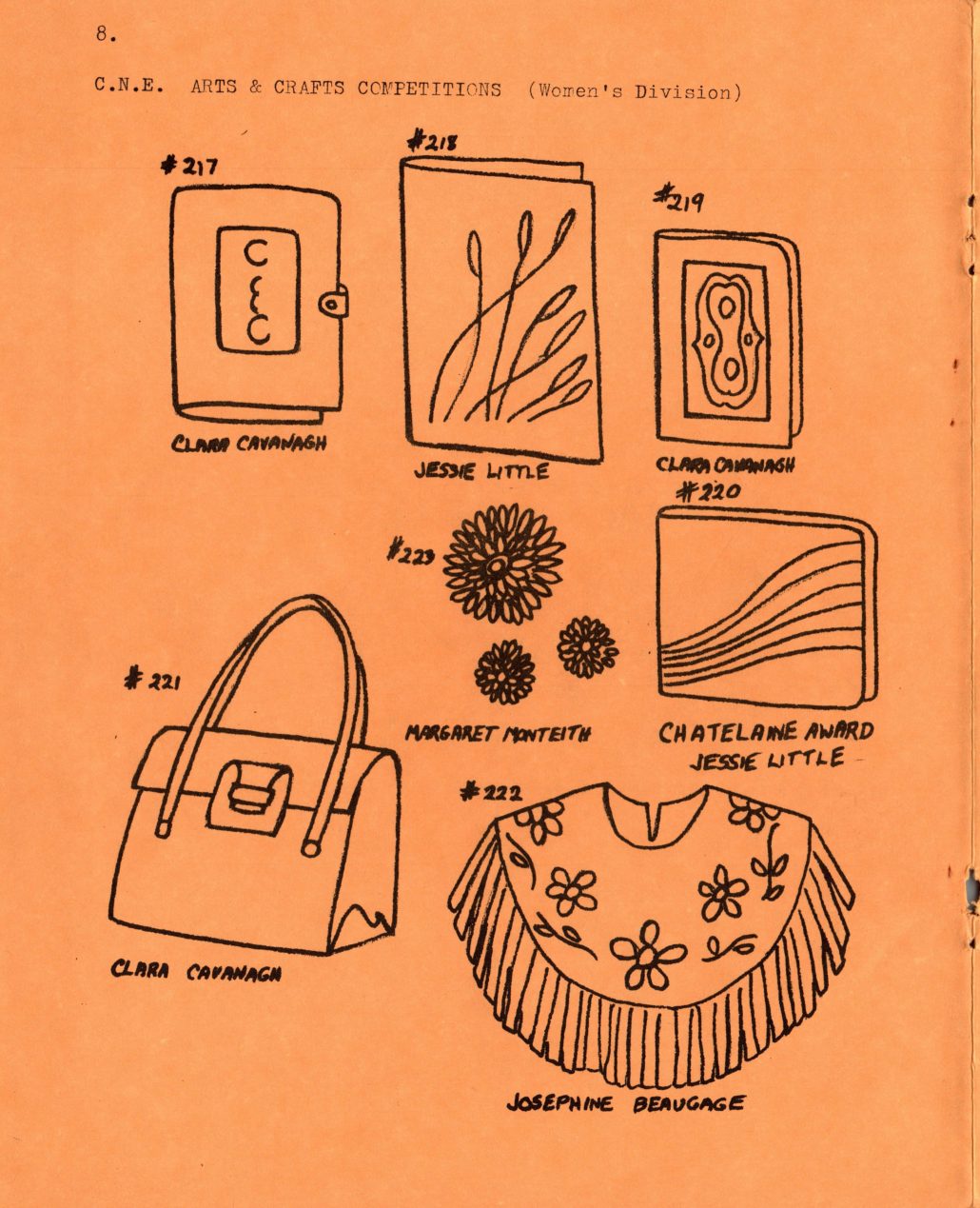
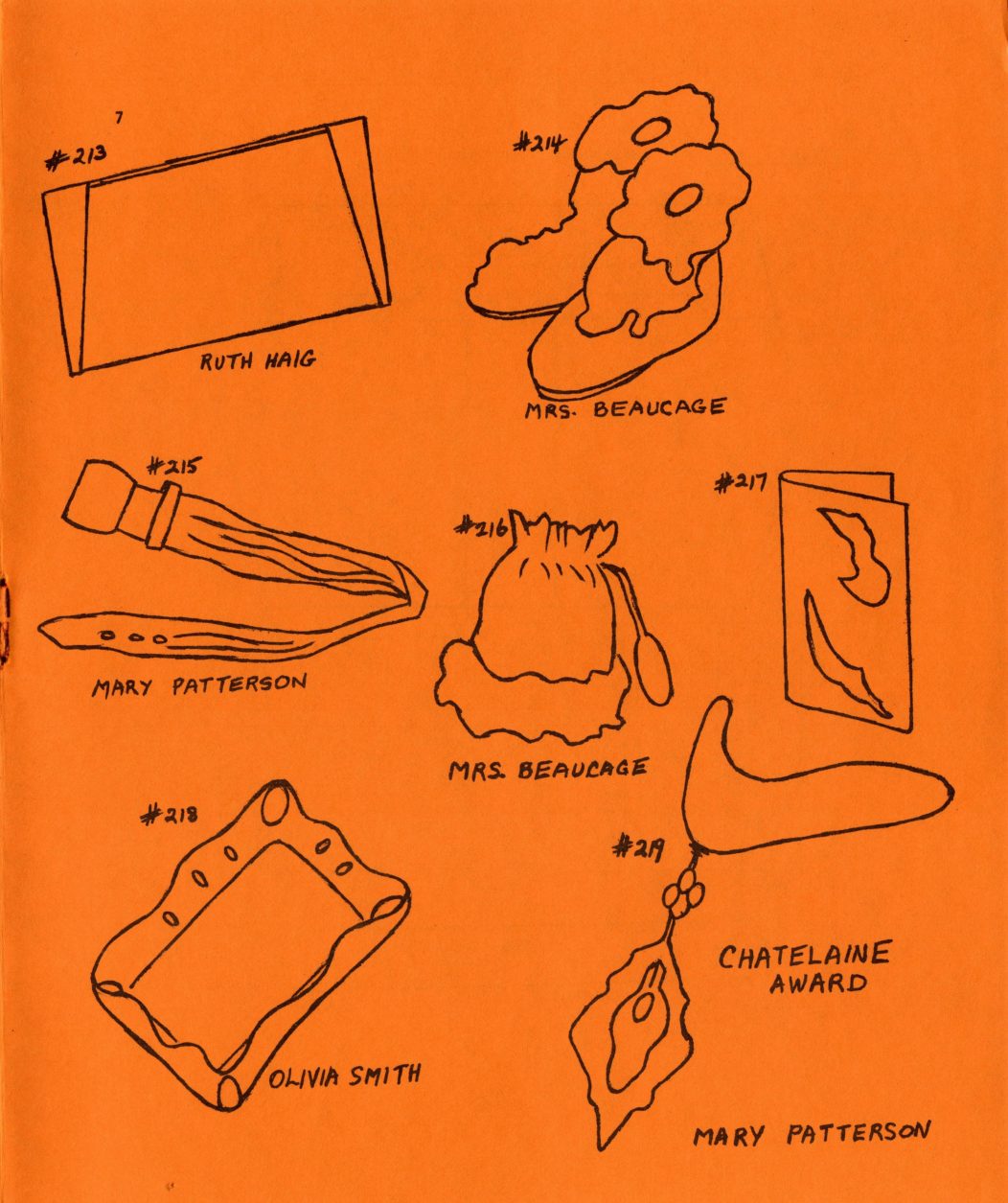
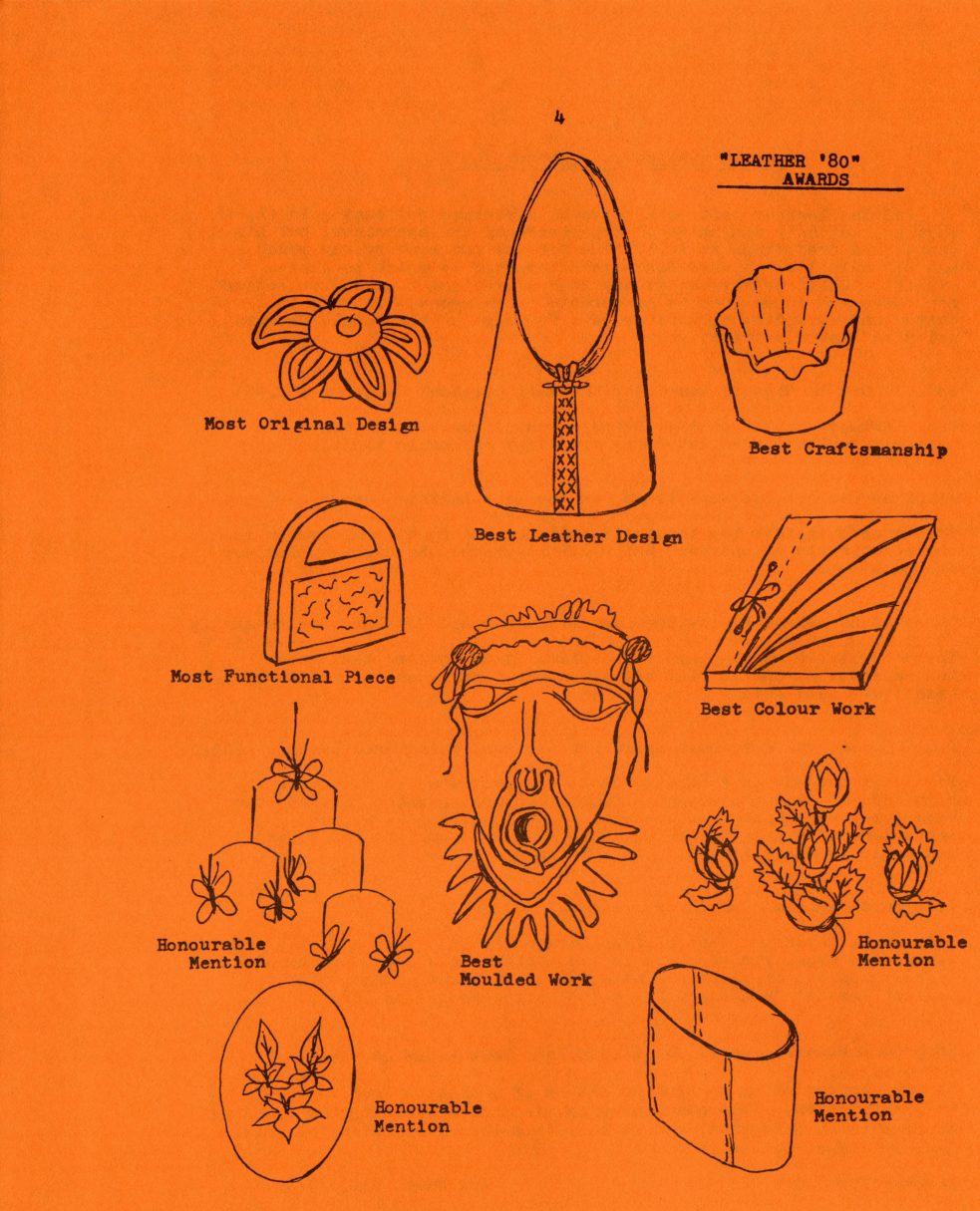
Three issues in a row went further than a prize list and drew the winning pieces themselves, captioned only with the maker's name — and later issues did the same — Autumn 1963 gave two pages to sketches of that year's C.N.E. winners, and Autumn 1964 did the same for the following year, the second page signed by the artist, and Autumn 1965 gave four plates to it: two of the Guild's own division and two of the Exhibition's separately numbered classes.
What the judges said
Three adjudicators' reports survive in full or in extract, and together they are the most searching outside criticism the Society ever published about its own work.
Harold J. Brennan, Director and Dean of Fine and Applied Arts at the Rochester Institute of Technology, judged in 1960: “Canada's crafts, as seen in this 1960 exhibition, reveal an emerging expressive power not yet defined, and superior skills not as frequently directed as one would wish to a search for new form and character.” He noted “a distinctive and national identity finding its expression in the Canadian crafts” and the contribution of “some of her more recent citizens with roots in the cultures of eastern and central Europe”. On leather he was severe: “technically superior but the craftsmen appeared too beguiled by tools and dyes to seek out the means by which this wondrously flexible, colourful and durable material can be more originally and honourably used.” (Autumn 1960, p. 5, reprinted from the Guild's Ontario bulletin of September 1960.)
Brennan adjudicated again in 1964 and gave the Society a practical instruction: quantity, not quality, was the problem, and craftsmen should send “not one or two, but three or four entries, which would stimulate competition”. On decoration he said the beauty of the leather should be emphasised and never wholly covered — a pen set “beautifully done” was criticised for having every surface stamped. (Autumn 1964, p. 2.)
Joseph Trippetti, Director of the League of New Hampshire Arts and Crafts, judged the Centennial year, 1967, and thought the demands of Centennial exhibitions had drained the entry: “noticeably absent were in-depth entries in woodcarving, enamels, leather, metalwork.” His verdict on what was there has stayed quotable: “Competency is probably the best overall description … Most important, though, are the ingredients I found absent — vitality, inquisitiveness, adventure. There is a ‘ho-hum’ feeling about the show.” Daphne Lingwood took the Woolworth $50 that year for a necklace and Janis Zalitis the Tandy credit note for leather-covered bottles; the newsletter's own comment was “We slipped and slipped badly at the 1967 C.N.E.” (Autumn 1967, p. 2.)
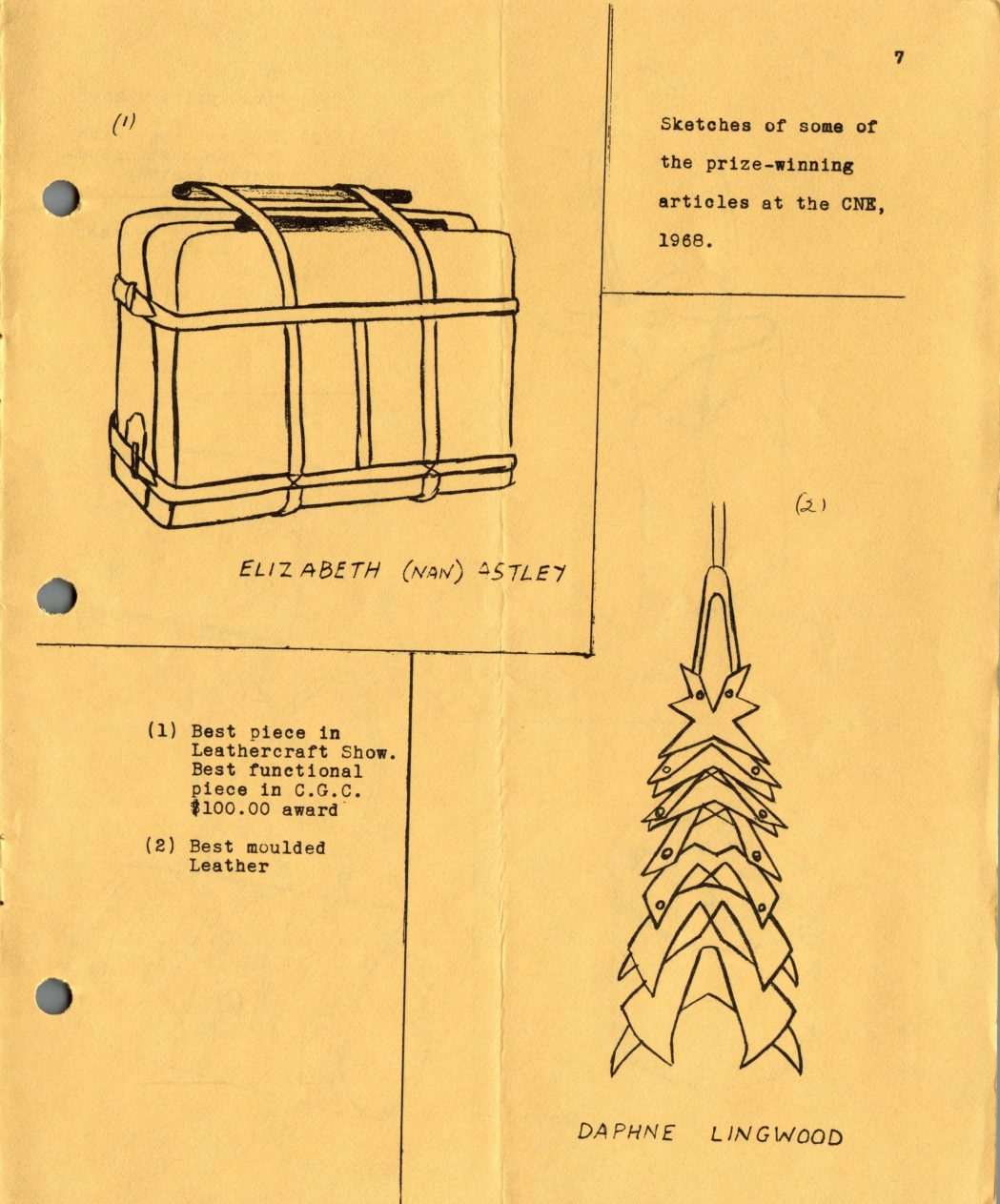
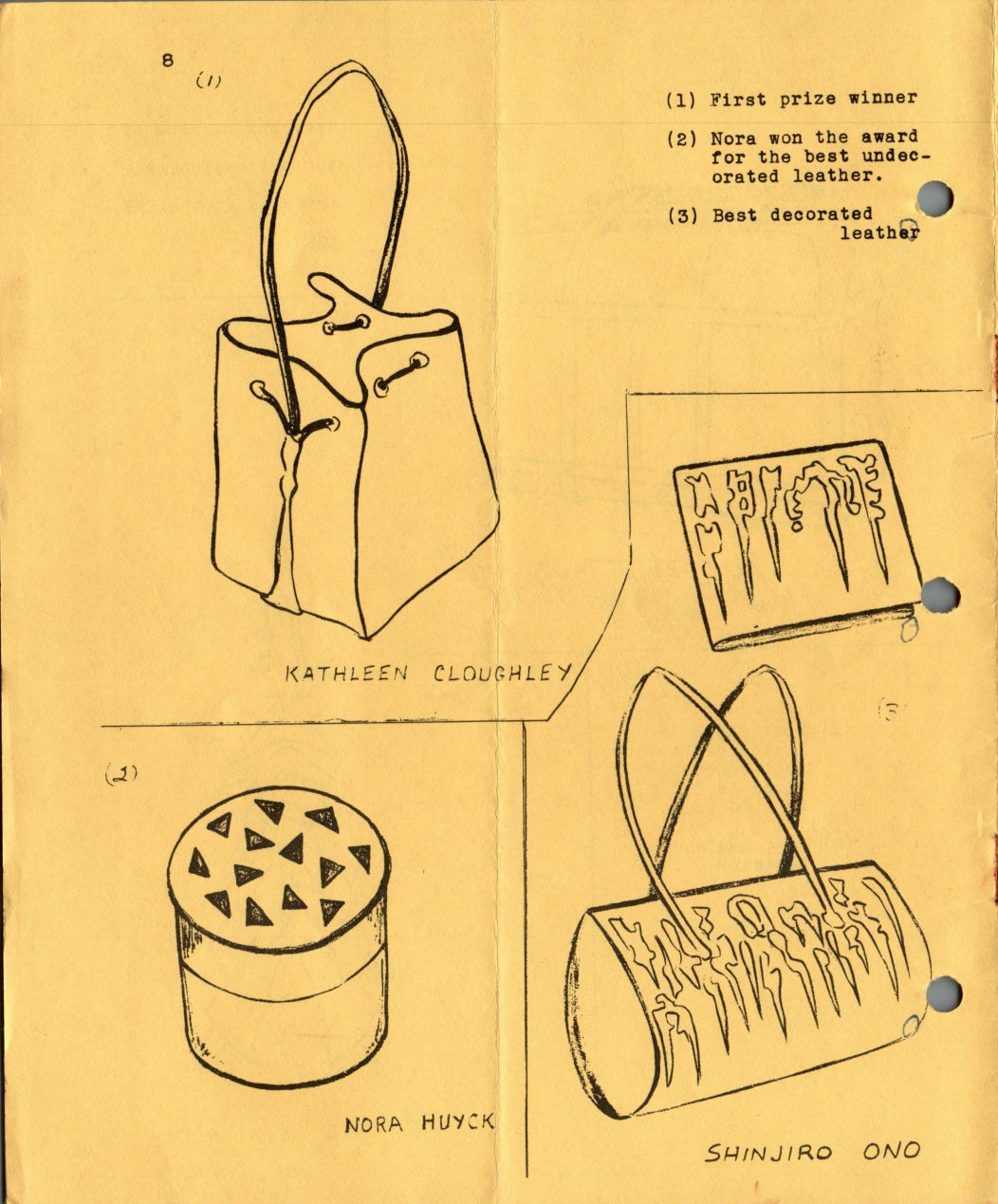
The following year's entry recovered, and this time the newsletter printed the full winners' list for the C.N.E.'s Guild of Crafts competition — headed “Winners of the [Guild] of Crafts Competition at the 1968 C.N.E.”, the G misprinted as a B — naming five prizes by class, sponsor and item: Elizabeth (Nan) Astley's Binder-briefcase took the overall Best Leather Entry, $50 from F.W. Woolworth Co. Ltd.; Shinjiro Ono's handbag and wallet took Decorated Leather, a $50 Tandy Leather credit note; Nora Huyck's letter caddy took Undecorated Leather, a $40 Lewiscraft credit note; Daphne Lingwood's wall hanging took Molded Leather, $25 from the Society itself; and Kay Cloughley's moulded tote bag took the Canadian Guild of Crafts (Ontario)'s $25 prize for any entry not by a previous winner. (Autumn 1968, p. 3.) The same issue also printed a page of sketches of the prize-winning pieces, drawn and named rather than photographed: Astley's case is a second, larger 1968 C.N.E. prize, the $100 Best Piece in the Leathercraft Show / Best Functional Piece award from the C.G.C. (the Guild's new name by then). (Autumn 1968, pp. 7–8.)
What the competition offered, year by year
| Year | Where at the C.N.E. | What the newsletter recorded |
|---|---|---|
| 1951 | C.N.E. leather class | 56 entries; 22 in original classes; workmanship “average to poor” |
| 1954 | Canadian Handicrafts Guild section | 5 first prizes; all but one entry by Society members; Marie Huper judging |
| 1955 | Guild section | 5 classes, $67 in prizes; every entry from a member; Hornyansky on the jury |
| 1956 | Guild section | 8 classes; first-time-competitor prizes added; entries taken 6–11 August |
| 1957 | Queen Elizabeth Building | Record 82 articles by 31 craftsmen; 8 categories, $210; Sylvia Hahn on the jury |
| 1958 | Queen Elizabeth Building | Largest prize list ever — two $100 special awards; entry “disappointingly few” |
| 1960 | Queen Elizabeth Building (former Kitchen Theatre); Guild section | Display and demonstration stage separated from other exhibits; Brennan's report — 9 winners incl. the President's medal |
| 1961 | — | No competitions — the Manufacturers Building destroyed by fire |
| 1962 | Guild section | Competition resumed; first-time-winner prize not awarded; 11 demonstrators |
| 1964 | Guild section; first C.N.E. Hobby Show | Brennan again; forty members demonstrated at the Hobby Show |
| 1965 | Guild division | Six classes; silver medal from the Guild's Ontario president |
| 1967 | Guild section | Trippetti's report; overall entry down, leather among the thinnest crafts |
| 1968 | Guild on the west side of the Better Living Building | Sale and competition separated; 838 articles sent, 573 sold in 1967 |
| 1969 | Arts, Crafts and Hobbies Building | 2,245 articles approved for sale, 1,654 sold; 74 members staffed the booth |
| 1973 | Guild section, renamed “Canadian Guild of Crafts” | Irva Ford’s Lady’s Belt, Best Leather Entry in Show |
| 1975 | Arts, Crafts and Hobbies Building | 32 members, 2,060 articles, 1,926 sold, gross $6,367.75 |
| 1976 | C.N.E. handicraft classes 217–223 | The Society's members placing in the Exhibition's own numbered classes |
| 1980 | Arts, Crafts and Hobbies Building, renovated | 20 members, 2,336 articles approved, 1,856 sold, $6,306.70 |
From competition to sales booth
The turn came in the middle 1960s, and it was not announced. In 1964 the Exhibition ran its first Hobby Show and asked the Society to take part; forty members demonstrated, the general manager wrote to thank them, and the Executive's own assessment of what the Society got out of it was candid — one new member, perhaps four custom orders, and some interest among night-school pupils. Their chief criticism was that demonstrators were not allowed to sell. (Autumn 1964, p. 2.)
Within five years selling was the main business. By 1968 the Guild's competition and the Society's own sale were in different buildings. The 1969 report, by the Toronto Branch convener, counted 2,245 articles approved for sale and 1,654 sold — an increase of 51 per cent in articles and 37 per cent in money on the year before — the work of forty craftsmen, every one of whom sold something; seventy-four members helped set up and staff the booth, with never fewer than four on duty, and the branches provided demonstrators on every day but one. (Autumn 1969, p. 6.)
The figures then run steadily for a decade and a half. 1971: forty-three members, 4,127 articles submitted, goods sold worth $4,286.91, reported by George McPhail as treasurer. 1975, the Society's twenty-fifth year: thirty-two members, 2,060 articles, 1,926 sold, gross $6,367.75, of which $1,212.62 came back to the Society as commission, and a paragraph on the three months of letters, entry lists, sales permits, passes and rotas that a booth costs before it opens. 1980: twenty members, 2,336 articles approved, 1,856 sold, $6,306.70, twenty per cent to the Society. (Winter 1971, p. 8; Autumn 1975, p. 4; Autumn 1980, p. 6.)
By 1984 the booth was paying “a substantial rental” for its space, and the Society chose to hold its commission at twenty per cent and widen the range of small, cheap items rather than take more from the makers. Gladys Riddell and Jack Meharg served as show convenors, entry blanks went out folded into the summer newsletter, and members were asked to vary their stock because “many people are purchasing small items as Christmas gifts to put away”. (Summer 1984, p. 16.)
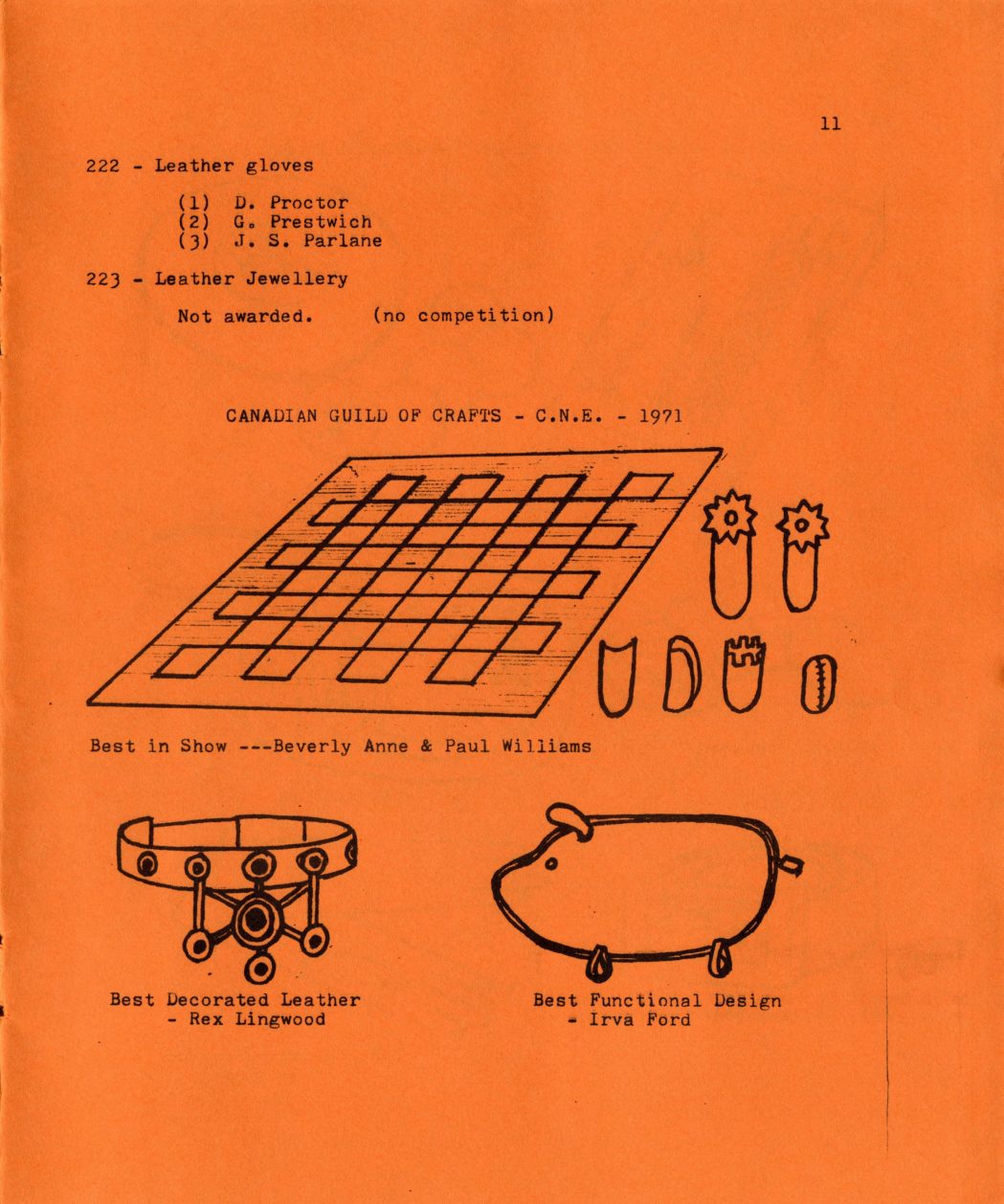
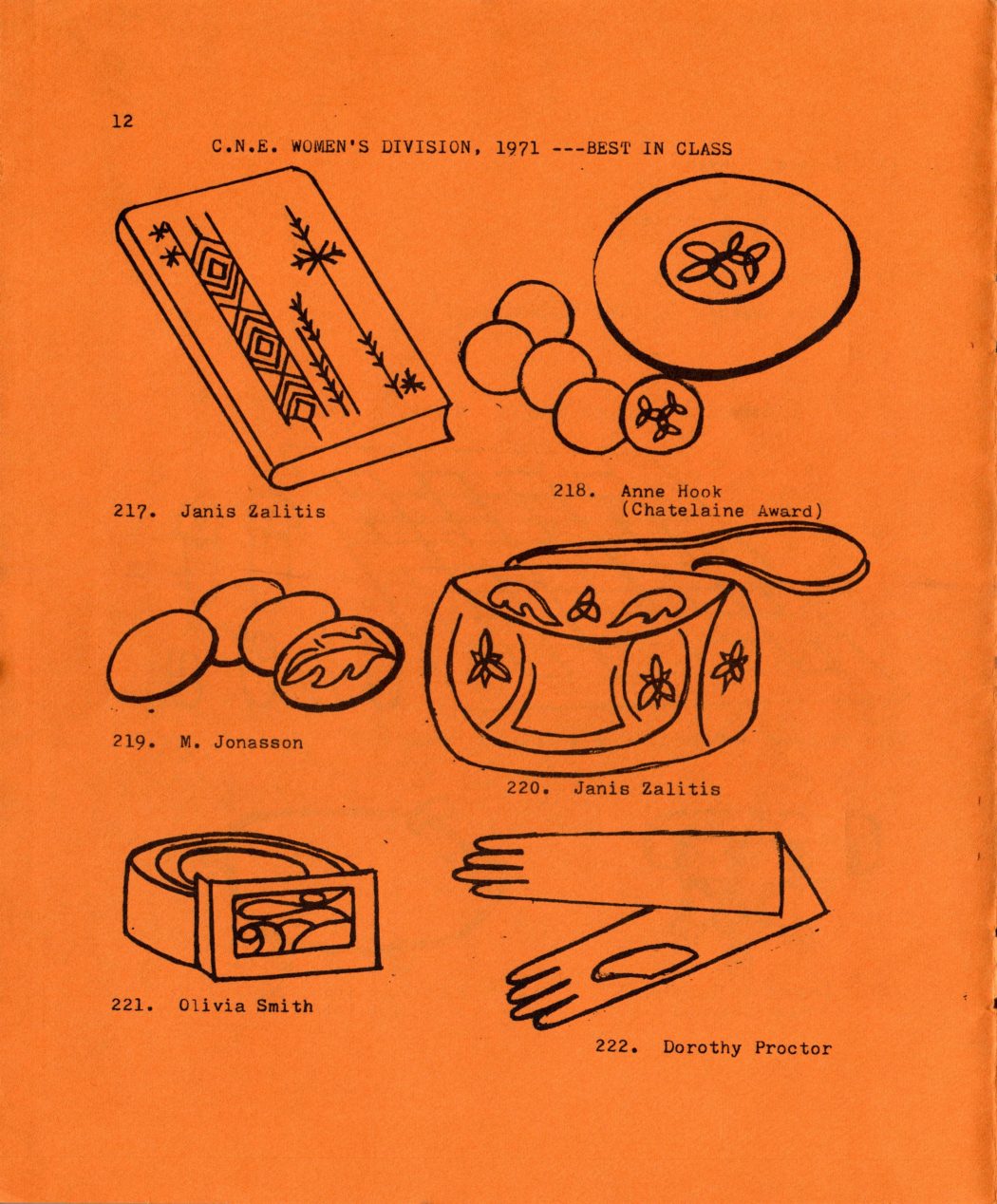
The competition did not stop; it changed hands. From the middle 1970s the prize lists the newsletter printed are the Exhibition's own numbered handicraft classes rather than the Guild's — class 217 household articles, 218 wearing apparel, 218A belts, 219 handbags, 220 pocket-sized items, 221 moulded articles, 222 Canadian Indian bead work, 223 leather jewellery — with Society members taking most of the places in them, and in 1976 the bead-work class drawing no entries at all. By 1980 the newsletter was counting members in the Hobby Classes, including two second prizes to Gertrude Hilder of Oxford Junction, Nova Scotia, in the classes for competitors aged sixty-five and over. (Autumn 1976, p. 3; Autumn 1980, p. 6.)
What it was worth
The clearest measure of what the competition meant to individual members is in an obituary. Endel Ruberg became an Associate in the summer of 1954, and that autumn took first prize for the best original entry in the Canadian Handicrafts section of the C.N.E. — “apparently this was the first time the award had been given to a leathercraftsman”. The following year he won the tooled or carved class with honourable mention in two more, and was made a Fellow. (Autumn 1989, p. 3.)
After 1989: the Society's own booth
The competition was the Canadian Handicrafts Guild’s; CSCL kept a second, separate presence at the C.N.E. besides — its own annual sales booth in the Arts, Crafts and Hobbies Building, the one the newsletters from the 1970s show approving thousands of members’ articles for sale each year. A tribute to Ruth Haig printed in the Society’s newsletter in 2005 describes that booth, where Haig herself had volunteered committee time, as already disbanded — one casualty, in the writer’s account, of a market for traditional leatherwork that “dwindled further” as synthetic leather-look fabrics and cheap imported leathergoods spread. No newsletter marks the year it closed; the 2005 account is the latest word the Society’s own record carries. (Summer 2005.)
Compiled from the Society’s newsletters, 1951–1989; every page quoted is linked.